KOSPI Erases 3% Opening Drop, Closes at Day's High as Chip Rout Pauses in Seoul
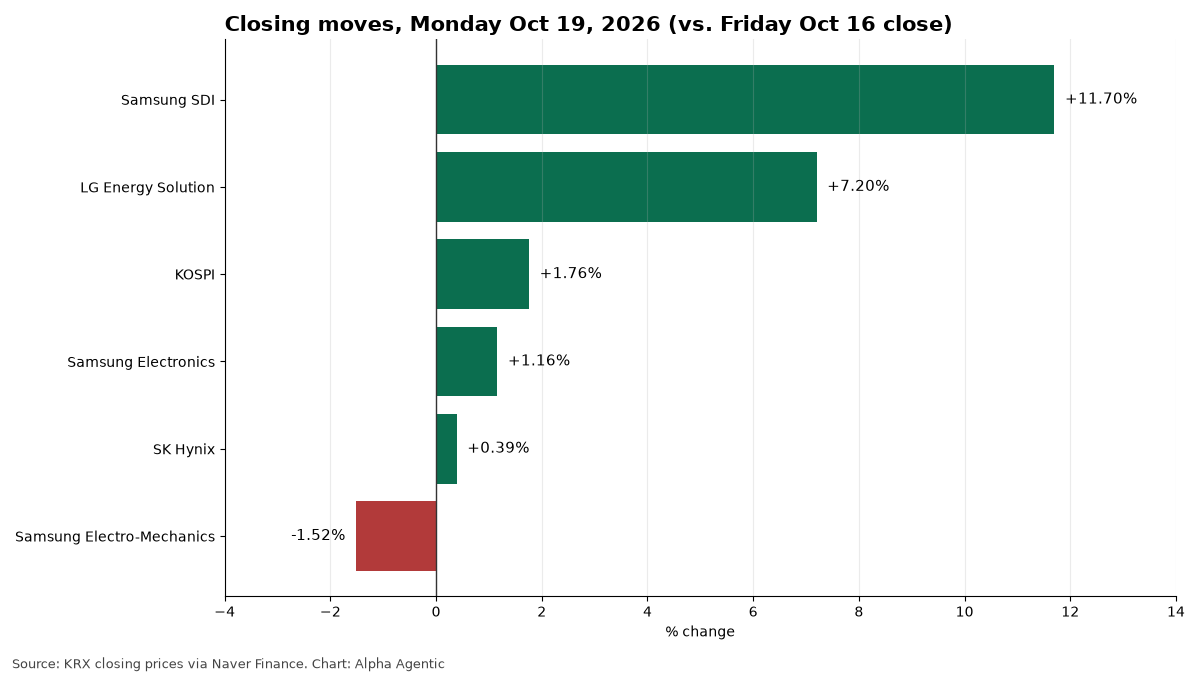
Korea's KOSPI erased a 3.17% opening drop to close up 1.76% at its session high after Friday's U.S. chip sell-off. Samsung Electronics and SK Hynix ended slightly higher. Battery makers led the rebound.
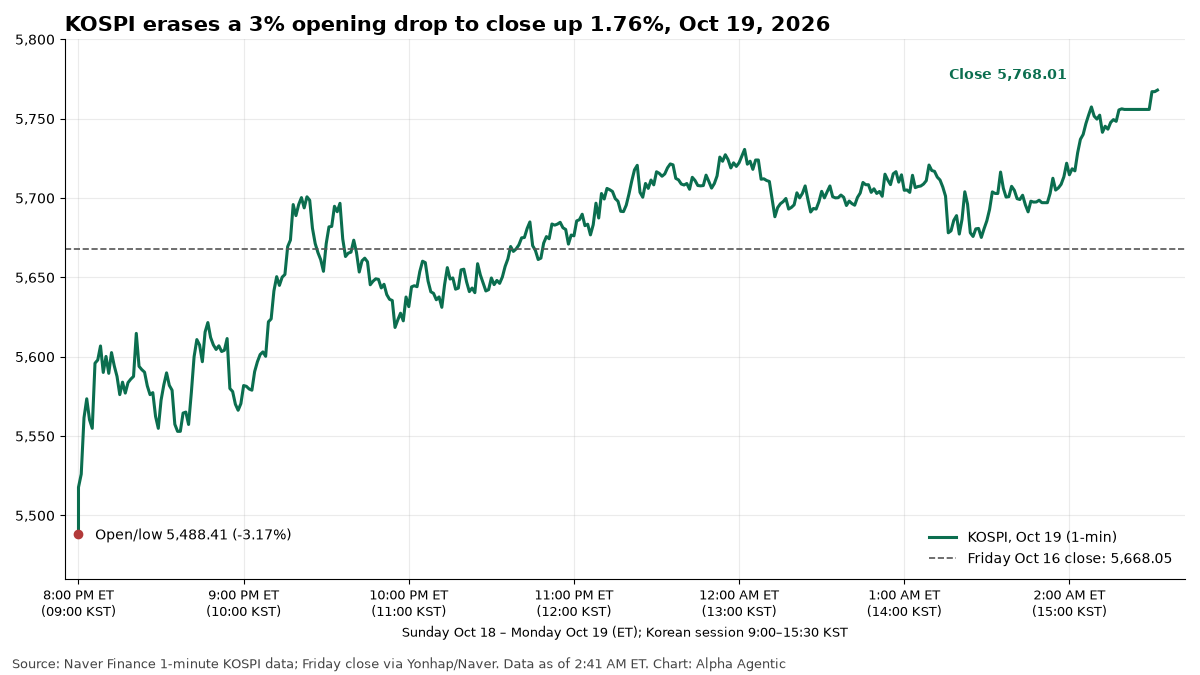
Korea's KOSPI opened down 3.17% on Monday after Friday's U.S. chip sell-off. It closed up 1.76%, at its high of the day. Seoul is one of the first markets to trade Friday's selling. Samsung Electronics (005930.KS) and SK Hynix (000660.KS) both ended higher. That makes Monday an early test of whether the AI hardware sell-off can keep going.
From a 3% gap down to the day's high
The index opened at 5,488.41, down 179.64 points from Friday's 5,668.05 close. That opening print was the session low.
Buyers stepped in within minutes. By 9:15 a.m. KST the loss had narrowed to 1.69%. After 10 a.m. the index briefly turned positive near 5,705, then dipped again. By about noon it was back above Friday's close. It stayed there for the rest of the session.
The KOSPI closed at 5,768.01, up 99.96 points, or 1.76%. The close was also the session high. That is a 279.60-point, or 5.1%, climb from the opening low.
Individual investors sold. Institutions bought. Preliminary exchange data showed individuals as net sellers of about 1.09 trillion won (roughly $815 million). Institutions were net buyers of about 576 billion won.
Chipmakers recover, but lag the index
Memory makers took the first hit. They did not lead the rebound.
Samsung Electronics opened down 3.94% at 207,000 won. It closed up 1.16% at 218,000 won.
SK Hynix opened down 4.72% and fell as much as 5.03%. It was still down more than 3% at 11:10 a.m. It finished up 0.39% at 1,277,000 won, its high of the day.
Samsung Electro-Mechanics (009150.KS) had been seen as core to Korea's AI value chain. It fell more than 7% intraday and closed down 1.52% at 1,170,000 won.
Battery stocks led the gains. Samsung SDI (006400.KS) rose 11.70% to 592,000 won. LG Energy Solution (373220.KS) gained 7.20% to 432,000 won. Investors are betting on more U.S. energy-storage demand. A Taiwanese tech outlet's report that Chinese storage makers will exit most of their U.S. business also circulated on Korean investor forums. Daol Investment & Securities analysts argue that storage can help power-hungry AI datacenters come online sooner.
The Friday sell-off Seoul was digesting
Friday's U.S. selling centered on doubts about debt-funded AI infrastructure. The Nasdaq Composite fell 572.99 points, or about 2.1%, to 26,140.03.
The Philadelphia Semiconductor Index fell 3.83% to 11,137.29. It was the index's eighth straight decline. That is its longest losing streak since 2008.
CoreWeave (CRWV) fell 11.91% as credit concerns resurfaced. Micron (MU) lost 5.63%. Broadcom (AVGO) fell 4.52%. AMD (AMD) dropped 5.95%. SK Hynix's Nasdaq-listed ADR (SKHY) slid 6.58%. Nvidia (NVDA) fell 1.43%. TSMC's ADR (TSM) lost 2.28%.
Elsewhere in Asia, the bounce did not spread. Japan's Nikkei 225 closed down 0.62% at 64,916.70. Taiwan's TAIEX closed down 0.61% at 46,822.08. TSMC closed flat in Taipei after a late rally.
U.S. stock futures were higher. As of 4 a.m. ET, when U.S. premarket trading opened, E-mini Nasdaq 100 futures were up 1.12% and E-mini S&P 500 futures were up 0.57%.
The Alpha Take
Seoul gave U.S. investors an early read on Friday's selling. The read was mixed.
The index move was strong. The KOSPI erased a 3% gap and closed at its high. A Shinhan Investment analyst tied the rebound to the bounce in U.S. futures and to foreign buying through futures and program trades. Nasdaq 100 futures were still up more than 1% overnight.
The chip signal was weaker. SK Hynix, a bellwether for the high-bandwidth memory used in AI accelerators, ended just 0.39% higher. Samsung Electro-Mechanics fell. Batteries did the heavy lifting, on hopes for U.S. storage demand. Japan and Taiwan also closed lower.
Mirae Asset Securities' Seo Sang-young told Yonhap that Friday's selling was a reassessment of debt-heavy investment models and high valuations, not a collapse in AI demand. If that reading holds, the pressure points for U.S. chip and AI stocks are financing and valuation. Debt-funded names like CoreWeave sit at the center of that. A Korean rebound led by batteries rather than memory leaves the AI-returns question open for the week's big-tech earnings.
What to watch
- Meta (META) reports third-quarter results after the close on Wednesday, Oct. 21, with a call at 4:30 p.m. ET. Its AI spending plans are the key read for infrastructure demand.
- Tesla (TSLA) posts results after the close the same day, with a webcast at 5:30 p.m. ET.
- SK Hynix holds its third-quarter earnings call on Oct. 28 at 9 a.m. KST, which is 8 p.m. ET on Oct. 27. Investors will look for HBM demand signals.