Anthropic's S-1: A Quarterly Operating Profit, an $80.7 Billion Paper Loss and a Compute Bill Left Blank
Anthropic's public S-1 shows $16.3 billion of first-half revenue and a second-quarter operating profit. About 90% of its $80.7 billion net loss is a non-cash mark on Amazon's notes. The harder question is the compute bill, and its headline total is still blank.
The thesis
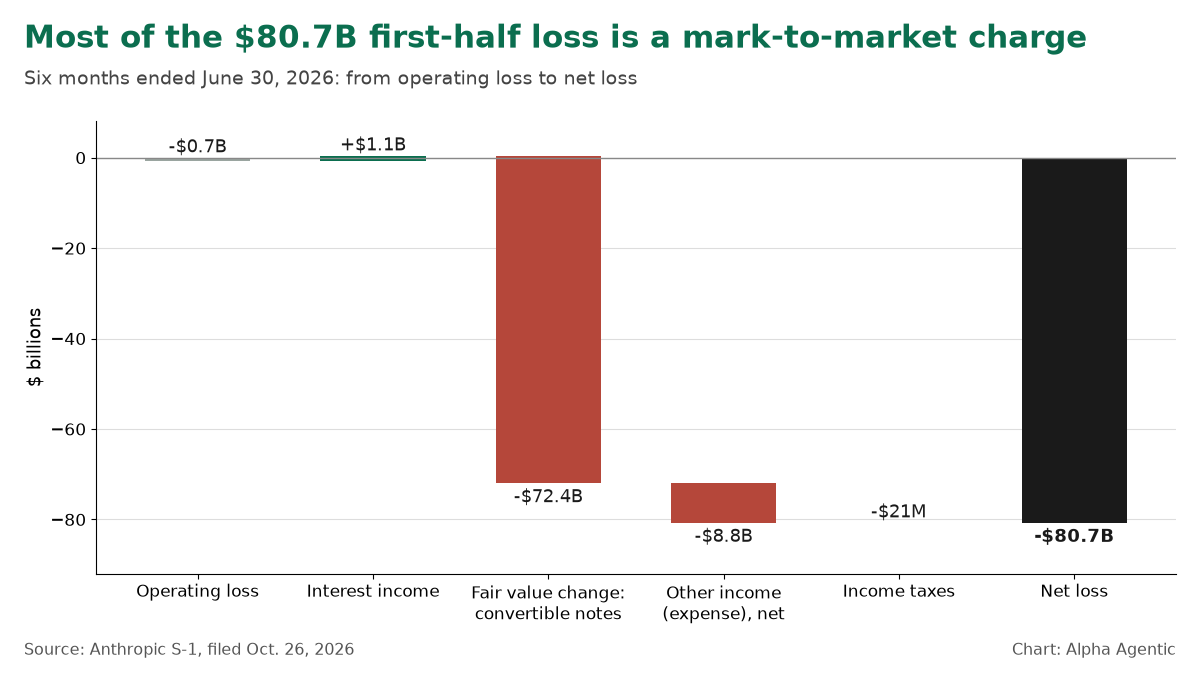
Anthropic, PBC has filed its IPO prospectus, and the headline loss is its least important number. The company, which plans to list on Nasdaq under the symbol ANT, lost $80.7 billion in the first half of 2026. About 90% of that was a non-cash charge from marking Amazon’s convertible notes to a higher company valuation. Above that line, the business posted a first-half operating loss of $693 million but a GAAP operating profit in the second quarter.
The real test is the compute contracts. Anthropic has signed take-or-pay deals with Alphabet’s (NASDAQ: GOOGL) Google, Amazon (NASDAQ: AMZN) and Microsoft (NASDAQ: MSFT), equipment leases with Broadcom (NASDAQ: AVGO), and GPU deals that run on NVIDIA (NASDAQ: NVDA) and AMD (NASDAQ: AMD) chips. Fixed or minimum commitments were about $265.6 billion at June 30, and deals signed or amended since then carry about $245 billion of minimum payments, some of them conditional. The all-in total is blank. Investors are being asked to back revenue that must keep outrunning a mostly locked-in bill.
The S-1 was filed with the SEC on Oct. 26 under registration number 333-299633. Its price range, share count and several key totals are blank.
What the numbers show
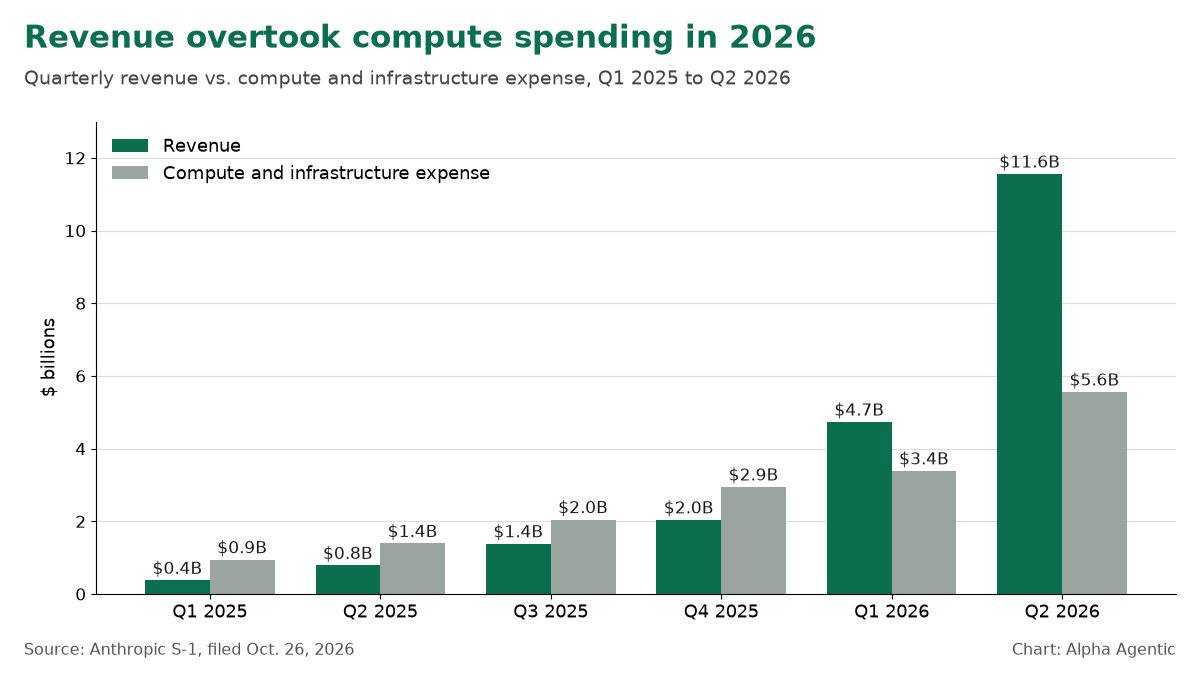
Revenue went from $41 million in 2023 to $386 million in 2024 and $4.6 billion in 2025. First-half 2026 revenue was $16.3 billion, up 1,300% from $1.2 billion a year earlier, according to the MD&A. Second-quarter revenue alone was $11.6 billion.
| $ millions | 2025 | H1 2025 | H1 2026 |
|---|---|---|---|
| Revenue | 4,585 | 1,163 | 16,286 |
| Compute and infrastructure expense | 7,326 | 2,334 | 8,945 |
| Operating loss | (8,060) | (2,135) | (693) |
| Change in fair value of convertible notes, derivative liabilities, and SAFEs | (34,308) | (10,942) | (72,388) |
| Net loss | (41,965) | (12,969) | (80,748) |
| Adjusted operating income (loss), non-GAAP | (4,854) | (1,849) | 1,618 |
| Net cash from operating activities | (2,637) | (1,513) | 3,929 |
Source: Anthropic S-1, Summary Consolidated Financial and Other Data and MD&A. 2025 includes a $1.5 billion charge for the Bartz copyright settlement.
Operating line: The first-half operating loss narrowed to $693 million. In the second quarter alone, Anthropic reported operating income of $974 million, an 8% margin. Its non-GAAP adjusted operating margin was 19% for the quarter and 10% for the half. That measure excludes $2.2 billion of first-half stock compensation.
Compute efficiency: Compute and infrastructure expense fell from 201% of revenue in the first half of 2025 to 55% a year later. Anthropic says second-quarter revenue grew 1,368% while compute and infrastructure expense grew 300%.
Gross margin: Anthropic does not report one. In 2025 it switched to grouping expenses by nature rather than function, but a functional table in the notes still lists first-half cost of revenue of $2.38 billion. Analysis: That implies a gross margin of about 85%, up from about 12% a year earlier. Treat it with care: most research and training compute sits in research and development.
Mix: Consumption-based, pay-per-token revenue was $13.1 billion, or 80% of the first half, and subscriptions $3.2 billion. U.S. billing addresses produced $11.8 billion and international customers $4.5 billion.
Cash and liquidity: First-half operating cash flow was $3.9 billion, and purchases of property and equipment were $482 million. At June 30, Anthropic held $112.4 billion of cash and cash equivalents and $19.3 billion of short-term investments. It had raised $141.1 billion in total, including $45.7 billion of Series H-1 preferred stock sold in May and June. In September it expanded its revolving credit facility to $15 billion, with a covenant to keep at least $5 billion of liquidity from the end of 2026. The Sept. 30 liquidity figure is blank.
Customers and concentration
Customers paying $100,000 or more over the trailing twelve months grew more than twelvefold in a year.
| Metric | Value | As of |
|---|---|---|
| Customers with $100,000+ TTM revenue | More than 11,900, up from more than 950 | Sept. 30, 2026 |
| Customers with $1 million+ TTM revenue | More than 1,900 | Sept. 30, 2026 |
| Customers with $10 million+ TTM revenue | About 250 | Sept. 30, 2026 |
| Net Revenue Retention | About 900% | Sept. 30, 2026 |
| Top five customers, share of revenue | About 25% | Nine months to Sept. 30, 2026 |
| Revenue via cloud marketplaces | 48% | First half of 2026 |
| Remaining performance obligations | $10.8 billion | June 30, 2026 |
Source: Anthropic S-1, Prospectus Summary, MD&A, Risk Factors and notes to the financial statements.
Large customers: No single customer topped 10% of revenue for the nine months to Sept. 30, per the risk factors. The notes show one customer at 11% of first-half revenue, and two at 12% each in 2025. Revenue from outside the top five rose to about 79% in the third quarter, from about 64% in the first.
Channel concentration: Cloud marketplaces handled 48% of first-half revenue and 58% of net receivables. Those clouds belong to companies that also sell Anthropic compute, invest in it and compete with it.
Revenue quality: Anthropic estimates that 5% to 7% of nine-month revenue came from customers later found to be breaking its usage policy or commercial terms. It expects that to fall after tighter enforcement in August and September.
Blanks: Third-quarter revenue, Run-Rate Revenue as of Oct. 31 and the trailing-twelve-month revenue share from $100,000-plus customers are all blank. Anthropic had about 5,300 employees at Sept. 30.
The $80.7 billion loss, explained
The line item is “Change in fair value of convertible notes, derivative liabilities, and SAFEs.” It cost $72.4 billion in the first half.
What drives it: Anthropic elected fair-value accounting for its convertible notes. When its valuation rises, the notes are worth more, and the holder’s gain is booked as an expense. The MD&A ties the first-half charge to the rise in enterprise valuation, and the $59.6 billion second-quarter charge to the Series H financing.
What it is not: Despite the name, none of it came from SAFEs. The filing says all SAFEs converted by the end of 2024 and none were outstanding in 2026. The charge sits on Amazon’s notes, which carry $6.2 billion of principal, bear no interest and were valued at $108.6 billion at June 30.
Non-cash: The $72.4 billion is added back in the cash flow statement, which is why operating cash flow was still positive. A second non-cash item, an $8.8 billion other expense, mostly reflects fair-value marks on note purchase agreements described in the notes, including Google’s and Amazon’s 2026 agreements. Non-GAAP adjusted net income, which excludes both items, was $2.7 billion for the half.
What happens at the IPO: The Amazon notes convert into non-voting Class N shares at the lower of their fixed conversion price or the IPO price. Conversion is capped so that Amazon holds no more than 12% of the company’s capitalization, unless Amazon waives the cap. Any portion that cannot convert is reissued as a rollover note, which keeps being marked to fair value and converts automatically at later quarter-ends. Analysis: The charge should shrink sharply at the IPO but may not vanish. After listing, any leftover notes would move with Anthropic’s share price.
The compute bill, by provider
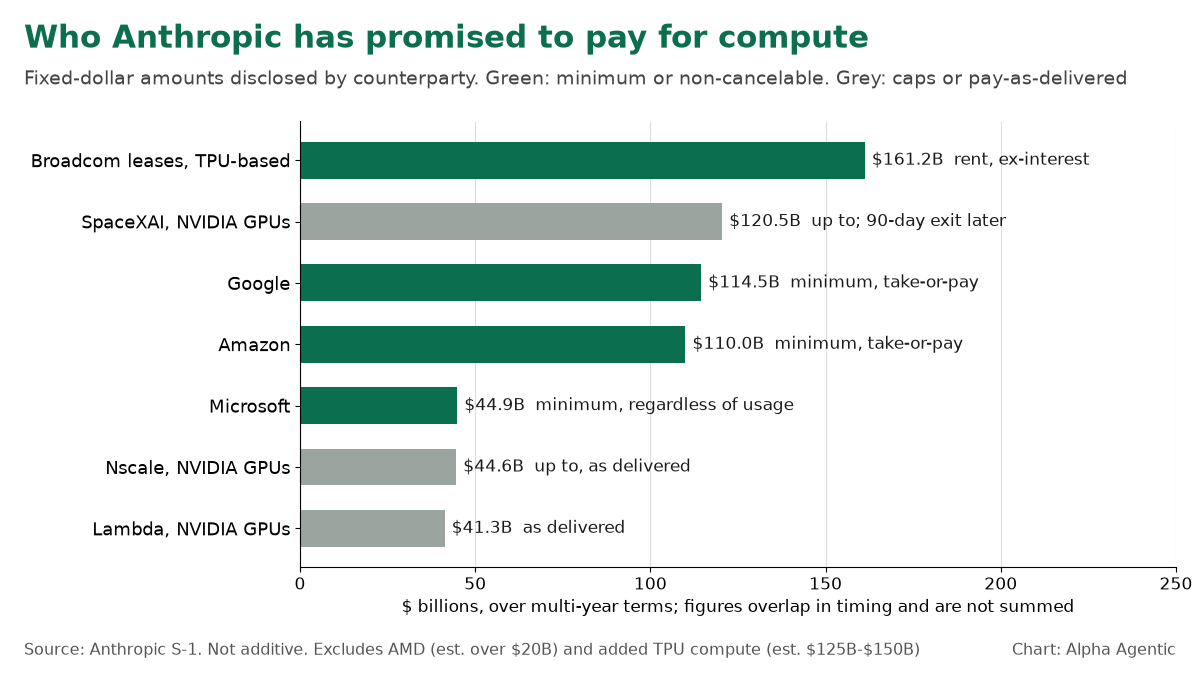
Anthropic runs Claude on AWS Trainium, Google TPUs, NVIDIA GPUs and AMD GPUs, managed as one “fungible pool” of compute, per the Business section. These are the largest arrangements in the MD&A’s Contractual Obligations section.
| Counterparty | Amount disclosed | Term | Cancellation and payment terms |
|---|---|---|---|
| At least about $114.5B | Apr. 2026 to July 2033 | Non-cancelable; shortfall paid as a true-up | |
| Google and other TPU providers | Est. $125B to $150B | Delivery 2028 to 2031 | Depends on capacity delivered; excluded from obligations table |
| Amazon | At least $110.0B | May 2026 to Apr. 2036 | Non-cancelable; shortfall paid as a true-up |
| Microsoft | At least $44.9B | Nov. 2026 to May 2033 | Owed regardless of usage; cancelable only for breach or undelivered tranches |
| Broadcom equipment leases, TPU-based | About $161.2B rent, ex-interest | Five-year leases | Non-cancelable finance leases; rent starts when equipment is ready |
| SpaceXAI, NVIDIA GPUs | Up to $120.5B | Into 2029 | About $3.1B a month at full delivery; 90-day exit after early 2027 |
| Nscale, NVIDIA GPUs | Up to about $44.6B | Into 2033 | Fees accrue as capacity is accepted |
| Lambda, NVIDIA GPUs | About $41.3B | Into 2034 | Fees accrue as delivered; $34.9B deal can end if site lease not secured |
| AMD Helios systems, MI450 | No fixed amount; expected above $20B | Initial tranche in 2027 | Non-cancelable by Anthropic except for breach |
Source: Anthropic S-1, MD&A, Liquidity and Capital Resources, Contractual Obligations.
Google/TPUs: Google holds the largest minimum cloud commitment, and its chips also sit behind the Broadcom leases. Google has also committed up to $20 billion under a 2026 note purchase agreement and holds an option to buy up to $10 billion of Class N stock alongside the IPO.
Amazon/AWS: The $110 billion deal runs the longest, to 2036. Amazon has also committed up to $15 billion under its own 2026 facility, available in $5 billion steps as compute capacity milestones are met.
Microsoft: The deal was signed in November 2025 and amended twice in 2026, most recently in October.
NVIDIA: The filing describes a strategic partnership with NVIDIA but no direct dollar commitment. NVIDIA capacity, including Grace Blackwell and Vera Rubin systems, comes through Microsoft, SpaceXAI, Nscale, Lambda and other clouds. SpaceXAI, formerly X.AI LLC, is a wholly owned subsidiary of SpaceX (NASDAQ: SPCX). Anthropic says it signed and amended several SpaceXAI agreements between May and October, and expects all capacity to arrive in December 2026.
AMD: AMD agreed to buy up to $5 billion of Anthropic’s Class N stock as its GPUs are delivered and deployed. The first milestone is expected in 2027.
The total: The prospectus says aggregate committed spend is “more than $ ,” with the figure blank, as are the amounts due before 2031 and in the next 12 months, and the year-by-year obligations table. The notes to the financial statements give pieces: about $265.6 billion of expected fixed or minimum guaranteed commitments at June 30, then about $245 billion of minimum payments under new or amended deals and about $21 billion of short-term commitments after that. Those pieces use different bases and may overlap, so we do not add them up.
Analysis: The same note put non-cancelable purchase commitments with more than a year left to run at $54.6 billion at Dec. 31, 2025. The June figure is measured differently, as expected fixed or minimum guaranteed payments, so we do not calculate a growth multiple. The direction is still clear. At $3.1 billion a month, the SpaceXAI deals alone would cost about $9.3 billion a quarter, more than Anthropic’s entire second-quarter compute and infrastructure expense of $5.6 billion. Anthropic itself warns that margins may compress as new capacity lands.
Datacenters: Anthropic Direct
Anthropic is adding a model it calls Anthropic Direct: it procures chips directly and runs them in dedicated facilities that others lease and operate to its specification. Its first such facility became operational in 2026.
How it works: Anthropic commits to datacenter space early, because buildings take longer and cost less, and to the larger chip spend later. It has a colocation agreement with Fluidstack and has signed datacenter leases directly. One lease signed in March 2026 is expected to start in 2027 and run 20 years.
Financing: To fund the Broadcom lease, Anthropic can issue up to $42 billion of convertible notes to Broadcom or a designated financing partner. They carry 9% paid-in-kind interest, or 13% if revenue conditions are missed. Anthropic has also guaranteed a provider’s power purchase contract for up to $500 million.
Power: Some planned sites rely on on-site natural gas generation, with fuel costs passed through to Anthropic “without cost caps.” Certain power and datacenter deals run 20 years with annual escalators. Anthropic has also pledged to cover consumer electricity price increases its datacenters cause. Its sites are mostly in the United States, and it is negotiating for sites abroad.
The risks that matter most
The risk factors run nearly 100 pages. Four stand out.
Compute take-or-pay: Anthropic’s revenue is mostly consumption-based and largely uncommitted, while its compute bills are multi-year and fixed. A default under certain commercial agreements could trigger cross-defaults on its credit facility and some convertible notes. The filing also admits Anthropic has “significantly underestimated” its compute needs in the past and has sought more compute from cloud providers than they were willing to supply.
Debt and convertibles: Total debt was $6.2 billion at June 30, all of it the Amazon notes. The bigger exposures sit outside that figure: the Broadcom leases, guarantees of subsidiary obligations, and $77 billion of undrawn note facilities with Google, Amazon and Broadcom. Much of that could be settled in, or convert into, Class N shares, diluting holders.
Power and energy: Grid capacity, interconnection queues, equipment lead times, and water and gas supply are named constraints. The filing notes that New York has paused state permitting for new large facilities and that Texas can curtail large loads in grid emergencies.
Regulation, export controls and policy: In June 2026, the Commerce Department imposed worldwide export restrictions on the Fable 5 and Mythos 5 models. Anthropic disabled both, then redeployed them after updating safeguards and once the restrictions were lifted. The filing also details a dispute with the Department of War. After Anthropic said its technology should not be used for mass domestic surveillance or fully autonomous weapons, the President said he had directed federal agencies to stop using it, and the department designated it a supply-chain risk. A district court largely ruled for Anthropic. A divided D.C. Circuit panel upheld one designation, under Section 4713, and Anthropic has asked the full court to rehear the case. The FTC also issued a civil investigative demand in October. Analysis: The investor issue is market access: federal work and sales to federal contractors could be limited, depending on the courts.
Governance: who controls Anthropic
Anthropic is a Delaware public benefit corporation, so its directors must balance shareholder returns against the interests of those affected by its conduct and its stated purpose: “the responsible development and maintenance of advanced AI for the long-term benefit of humanity.”
| Class | Votes | Economic rights | Holder |
|---|---|---|---|
| Class A | 1 per share; limited to 49.9% of total voting power | Yes | Public investors, founders, employees |
| Class N | None, except as required by law | Yes; converts to A if sold to an outside party | Mainly strategic partners, incl. Google and Amazon |
| Class T | Elects four of seven directors | No | Long-Term Benefit Trust |
| Class F | Fixed 50.1% of general voting power | No | Founder LLC of the seven co-founders |
| Class E | Limited matters only | No | Employees other than co-founders |
Source: Anthropic S-1, Prospectus Summary, Our Capital Structure, and Management.
The Long-Term Benefit Trust: The LTBT has five authorized seats for financially disinterested trustees, one of them vacant. Through its single Class T share, it elects and removes four of the seven directors, per the governance section. The initial Class T directors are Reed Hastings, Vas Narasimhan and Christopher Liddell, with one seat vacant. For one seat, the LTBT needs the nominating committee’s concurrence or, failing that, a vote of the Class E employee shares. It has no day-to-day management role.
The founders: The co-founders’ LLC elects the other three directors together with Class A holders. Its 50.1% voting share does not dilute as new shares are issued. It and the Class E shares are redeemed for nothing after a 450-day transition, which starts once there have been fewer than three continuing founders for 90 straight days. Together, the LTBT and the Founder LLC can elect the entire board. Anthropic will be a Nasdaq “controlled company,” though it expects to use the exemption only for its nominating committee.
Major holders: Amazon and Google will each hold more than 5% of the stock after conversions, but in non-voting Class N shares. That is why neither appears in the principal stockholders table, which lists only voting securities. Their share counts are blank. Each co-founder beneficially owns roughly 230 million to 245 million Class A shares; five are listed as “other selling stockholders,” with amounts blank.
Public benefit shares: Anthropic contributed 846.8 million Class N shares, 5% of fully diluted shares, to its own Public Benefit Fund. It may add up to 2% more each time the share price rises 50% above the last milestone, starting from the IPO price. Analysis: That is a built-in dilution mechanism tied to share-price gains.
Offering terms and what is blank
| Item | What the S-1 says |
|---|---|
| Exchange and ticker | Nasdaq Global Select Market, “ANT” |
| Price range, shares offered, proceeds | Blank |
| Underwriters | Goldman Sachs and Morgan Stanley as representatives, with J.P. Morgan, Citigroup and 18 others named |
| Selling stockholders | Yes, including five co-founders listed by name; share counts blank |
| Use of proceeds | General corporate purposes, including compute and infrastructure, hiring, possible acquisitions, and RSU tax withholding |
| Concurrent placement | Google option to buy up to $10B of Class N at the IPO price |
| Lock-ups | Earlier of 180 days or Q1 2027 results for most holders; earlier of 365 days or Q3 2027 results for co-founders and 0.5%+ holders, with staged early releases |
| Directed share program | None found in this filing |
Source: Anthropic S-1, cover page, The Offering, Use of Proceeds, Shares Eligible for Future Sale and Underwriting.
The use of proceeds names no specific acquisitions or projects. The lock-up terms let some directors, officers and employees sell up to 10% of their shares from the first trading day. Each founder may transfer up to 29% after first-quarter 2027 results or 180 days, whichever comes first. The co-founders have pledged to give 80% of their equity to charity, but the filing calls those pledges voluntary and revocable.
What the filing confirms from our earlier report
On Oct. 20, we reported on a confidential draft of the prospectus as described by The Wall Street Journal. The public filing confirms most of it.
| WSJ account, Oct. 20 | Public S-1 |
|---|---|
| $16.3B first-half revenue vs. $1.1B | Confirmed: $16,286M vs. $1,163M |
| Nearly $9B compute spend vs. $7.3B in 2025 | Confirmed: $8,945M vs. $7,326M compute and infrastructure expense |
| $80.7B net loss, $72B non-cash | Confirmed: $80,748M; $72,388M fair value charge, added back as non-cash |
| About 20% of revenue from two customers | Not shown for first half: one customer at 11%; two at 12% each in 2025 |
| Google Cloud $111B | Updated: at least about $114.5B after amendments |
| AWS $110B | Confirmed: at least $110.0B |
| Microsoft $31B | Updated: at least $44.9B after October amendment |
| About $450B total; up to $750B | Not confirmed: aggregate total is blank |
| No ticker or venue | Now disclosed: Nasdaq Global Select, “ANT” |
Source: Anthropic S-1; The Wall Street Journal, as reported by Alpha Agentic on Oct. 20.
The filing also confirms that Anthropic sought more compute than cloud partners would supply, and it discloses about $161.2 billion of Broadcom equipment lease rent, the same figure Reuters reported in September from an earlier draft.
The bull case and the bear case
Bull case: Anthropic earned a GAAP operating profit in the second quarter, first-half operating cash flow was positive, and second-quarter revenue was double compute expense. Large customers grew more than twelvefold in a year, and concentration is easing. A $131.7 billion cash and short-term investment balance plus partner financing gives it time. Compute signed early, while supply is scarce, could prove cheap if demand keeps growing, and four chip families limit dependence on any one vendor.
Bear case: The profit is one quarter old and came before most committed compute arrived. Anthropic says margins may compress as capacity lands and as it buys pricier short-term compute. Revenue is mostly pay-as-you-go; hundreds of billions in obligations are fixed. Its biggest suppliers are also its investors, distributors and competitors. Founders and a trust control the board; public holders get at most 49.9% of the vote. Federal market access is in court, and export rules have already pulled two models offline once.
The Alpha Take
The $80.7 billion loss is mostly an accounting echo of a soaring private valuation, and it should largely fade once the notes convert. The operating business is the story, and for now it works: revenue is growing far faster than compute cost, and operating cash flow turned positive.
What investors cannot yet see is the full size of the bet. Commitments have climbed from tens of billions to hundreds of billions since December, and both the headline total and the next 12 months of payments are blank. Until those figures are filled in, any valuation rests on an assumption that demand keeps outrunning supply, and the governance structure limits public holders’ say if it does not. This is analysis, not investment advice.
What to Watch
- The amended S-1: The aggregate commitment total, the next-12-month figure and the contractual obligations table.
- Price range and share count: The first look at valuation, and how much of Amazon’s notes convert versus roll over.
- Third-quarter results: Q3 revenue, Run-Rate Revenue and whether operating margins hold as SpaceXAI capacity ramps.
- Hyperscaler earnings: Alphabet and Microsoft report Oct. 28 and Amazon Oct. 29. Watch backlog and any comments on Anthropic.
- Google’s $10 billion option: Whether Google buys Class N shares alongside the IPO.
- Courts and export rules: The D.C. Circuit’s response to Anthropic’s rehearing request, and any new export limits on models.
- Lock-up releases: Staged early releases start on the first trading day.