Daily Brief: Meta Narrows Its Capex Range, Lam Flags Supply Snags
Meta raised the floor of its 2026 capex range and created a non-voting share class, while Lam said supply limits held back its outlook and Tesla cut its 2026 capex plan to about $20 billion.
Meta raised the floor of its 2026 capex range and created a share class that could help pay for it, while Lam Research and Texas Instruments said AI and data center demand kept lifting results. But supply limits at Lam and a smaller 2026 budget at Tesla suggest spending may reach hardware orders unevenly.
Meta narrows its 2026 capex range and creates a non-voting share class
Meta Platforms (NASDAQ: META) said third-quarter revenue rose 26% to $64.60 billion and capex, including finance-lease principal, was $34.91 billion, leaving free cash flow at negative $2.12 billion. It now expects 2026 capex of $135 billion to $145 billion, narrowed from $130 billion to $145 billion, and guided fourth-quarter revenue to $73 billion to $76 billion. Its board approved a publicly listed, non-voting Class C stock, effective Jan. 19, 2027, to be distributed as a one-time stock dividend; Meta said it can be used for capital raising, employee pay and acquisitions. Shares closed at $697.52 before the release, ended after-hours trading up 2.2% and were down about 1.2% in early premarket trading Thursday. Our Hyperscaler Capex Tracker now reflects the new range.
What It Means for Investors: With $85.82 billion spent through September, the new range implies fourth-quarter capex of $49 billion to $59 billion by our calculation, Meta's largest quarter yet, which could support near-term orders for Nvidia (NASDAQ: NVDA) and other suppliers. With free cash flow negative, the new class gives Meta another way to fund the build, which could dilute holders if it sells shares.
Lam posts record revenue but says supply limits held back its outlook
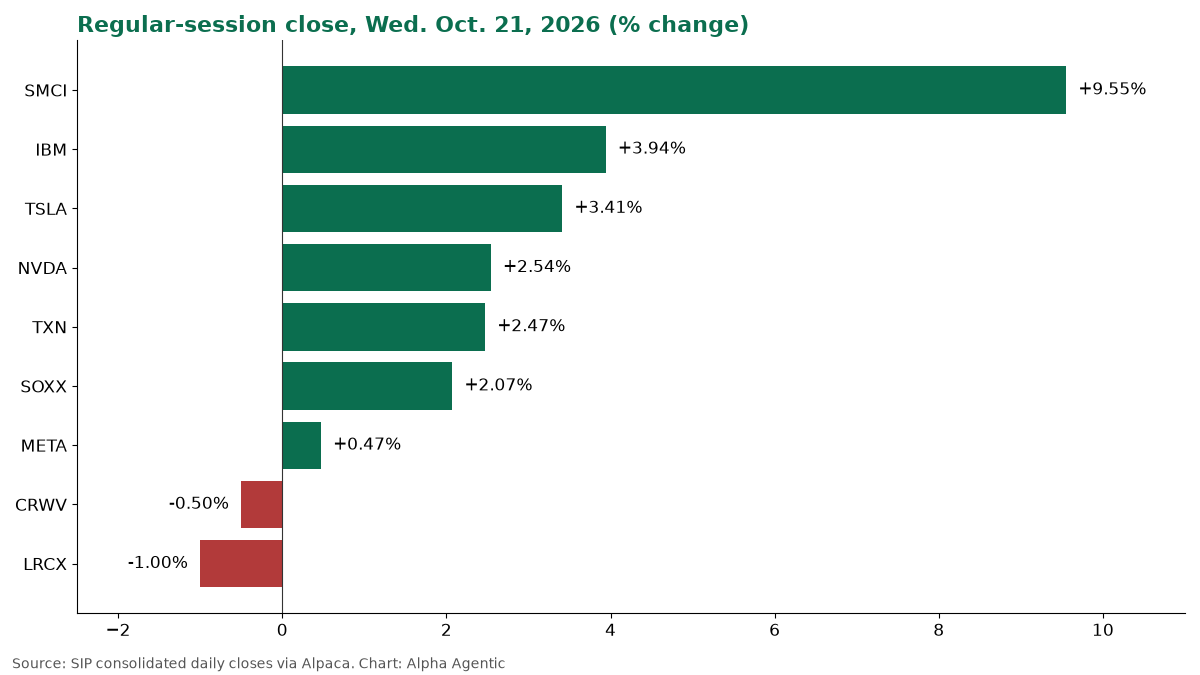
Lam Research (NASDAQ: LRCX) reported record revenue of $8.22 billion for the September quarter, up 22% from June, and non-GAAP EPS of $2.20. It guided December-quarter revenue to $8.6 billion, plus or minus $400 million. On the call, CFO Doug Bettinger said the guide "would have been a bit higher if not for some near-term supply chain constraints," with affected shipments moving into March, and that China's share of revenue would be "meaningfully down" in December, according to a call transcript. CEO Tim Archer gave a preliminary 2027 wafer fab equipment outlook of more than $200 billion. Shares fell 1.00% in the regular session to $260.81 before the release, then ended after-hours trading down 7.4% and were down about 8% in early premarket trading Thursday.
What It Means for Investors: If supplier bottlenecks push shipments into March, toolmakers such as KLA (NASDAQ: KLAC) and Applied Materials (NASDAQ: AMAT) could see similar timing shifts, while Lam's 2027 view could support expectations for memory and foundry spending.
Source: Lam Research · Stock Analysis transcript
Texas Instruments' revenue rises 28% as data center keeps growing
Texas Instruments (NASDAQ: TXN) reported third-quarter revenue of $6.06 billion, up 28% from a year earlier, with EPS of $2.62. CEO Haviv Ilan cited "continued broad growth in industrial, automotive and data center," and TI guided fourth-quarter revenue to $5.80 billion to $6.30 billion. The stock rose 2.47% in the regular session to $284.65 before the release, then ended after-hours trading up 1.3% and was down about 1% in early premarket trading Thursday.
What It Means for Investors: If power-management chips for AI servers keep growing alongside industrial demand, analog suppliers could gain from the buildout without the pricing swings of leading-edge chips.
Tesla cuts its 2026 capex plan to about $20 billion
Tesla (NASDAQ: TSLA) CFO Vaibhav Taneja said on the earnings call that 2026 capex should be about $20 billion, funded mainly from operating cash flow, and that Tesla secured capacity to borrow up to $30 billion, with no draws planned this year, according to a call transcript. The prior forecast was more than $25 billion, Reuters reported. Tesla's third-quarter update shows capex of $4.73 billion and free cash flow of $1.53 billion, and it plans to reach 400 megawatts of AI training compute by year-end.
What It Means for Investors: Lower spending this year could ease near-term cash pressure, but Taneja said capex "for the next few years would continue to expand," so AI chip and compute suppliers could see Tesla demand step up later.
Source: Tesla · Stock Analysis transcript · Reuters via Investing.com
Nebius signs a preliminary deal for up to 50 MW at a Saudi AI campus
HUMAIN and DataVolt announced a preliminary framework agreement under which Nebius (NASDAQ: NBIS) would take up to 50 megawatts, half of the first 100 MW under construction in a planned 360 MW first phase at NEOM's Oxagon. The companies said the capacity is expected to come online in phases from the fourth quarter of 2027, with Nebius deploying Nvidia-powered infrastructure.
What It Means for Investors: If the framework becomes a binding contract, it could add Saudi capacity for Nebius starting in late 2027, but preliminary terms can shift before signing.
What to Watch Today
- 8:30 a.m. ET: Weekly initial jobless claims from the Labor Department.
- After the close: Bloom Energy (NYSE: BE), a fuel-cell supplier to data centers, reports third-quarter results, with a call at 5:00 p.m. ET.
- Fed quiet period: Fed officials are in their pre-meeting blackout ahead of the Oct. 27-28 FOMC meeting.