Daily Brief: Musk Says SpaceX Closed $40B in GPU Debt, Big Tech Earnings Loom
Musk says SpaceX closed $40 billion in GPU debt as Big Tech earnings week begins, Goldman cuts its KOSPI target, and Treasury proposes wider outbound investment rules.

AI stocks head into a heavy week of Big Tech earnings after financing worries sparked Thursday's selloff, and Elon Musk said SpaceX has closed $40 billion of debt to buy GPUs. Goldman Sachs cut its KOSPI target, Treasury proposed wider outbound investment rules, and Firebird won a license for 45,000 Nvidia GPUs in Kazakhstan.
Musk says SpaceX closed $40 billion in debt to buy GPUs
SpaceX (NASDAQ: SPCX) has closed $40 billion in debt financing to buy GPUs, CEO Elon Musk said in posts on X on Sunday, according to CNBC. Musk said the financing is mostly callable debt and that the chips are expected to arrive in the first half of 2027. Bloomberg had earlier reported, citing people familiar with the matter, that the proposed financing would use a special purpose vehicle to keep the debt off SpaceX's balance sheet, CNBC said. Musk also said debt markets have largely shut off financing for companies without substantial revenue outside AI data centers, and predicted that more than 200 neoclouds would face failures and consolidation.
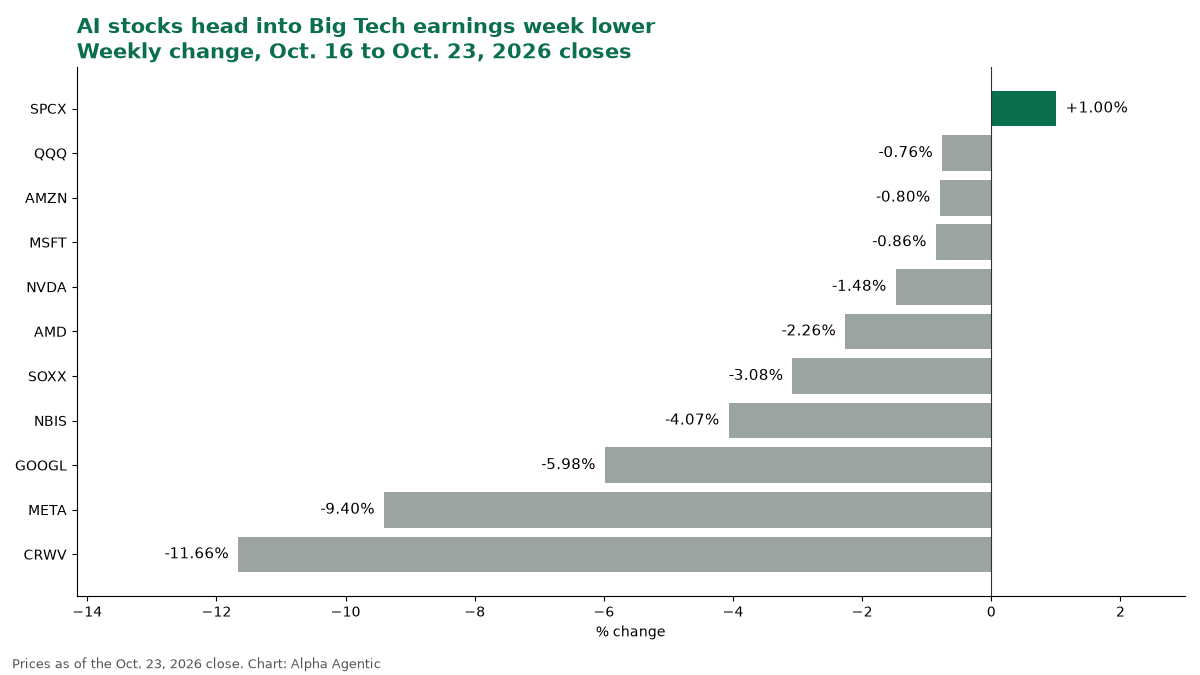
What It Means for Investors: If lenders keep favoring borrowers with revenue outside AI, diversified buyers like SpaceX could keep winning GPU supply while pure-play neoclouds such as CoreWeave (NASDAQ: CRWV), down 11.66% last week, face higher funding costs.
Microsoft, Alphabet and Amazon report this week after an AI selloff
Microsoft (NASDAQ: MSFT) and Alphabet (NASDAQ: GOOGL) report after the close on Wednesday, and Amazon (NASDAQ: AMZN) follows Thursday, among about 160 S&P 500 companies reporting this week. Alphabet fell 5.98% last week and Meta Platforms (NASDAQ: META) lost 9.40%, while Microsoft and Amazon each slipped less than 1%. CNBC said investors are looking for clues on how companies are financing the AI boom.
What It Means for Investors: Capex guidance and cloud growth from the three could set the tone for chip, neocloud and power stocks. If spending plans rise without matching revenue growth, last week's financing worries could deepen.
Goldman cuts its KOSPI target by 25% as memory stocks slide
Goldman Sachs (NYSE: GS) cut its 12-month KOSPI target to 9,000 from 12,000, citing volatility and slowing earnings momentum, but kept its overweight stance on Korean equities, saying the new target still implies more than 60% upside. The bank said the KOSPI has fallen 40% from its record high and that memory chip valuations imply a roughly 65% decline in 2027 earnings, CNBC reported.
What It Means for Investors: If memory earnings hold up better than those valuations imply, Samsung Electronics (KRX: 005930) and SK Hynix (KRX: 000660) could rebound, but continued foreign selling, which Goldman put at $1 billion, could keep pressure on Korean chip stocks.
Treasury proposes wider limits on U.S. outbound investment in AI and chips
The Treasury Department proposed rules under the COINS Act that would ban some U.S. investments, and require notice of others, in companies tied to countries of concern working on semiconductors, AI, quantum, supercomputing, hypersonics and, newly added by Treasury, biotechnology. Beyond China, Hong Kong and Macau, the law adds Cuba, Iran, North Korea, Russia and Venezuela as countries of concern. The proposal is published in the Federal Register today, with comments due Dec. 7.
What It Means for Investors: If the rules are finalized as proposed, U.S. venture and private equity funding for Chinese AI and chip startups could shrink further, leaving those firms more reliant on domestic capital.
Source: U.S. Treasury · Federal Register
Firebird gets a U.S. export license for 45,000 Nvidia GPUs in Kazakhstan
Firebird has secured a U.S. export license for 45,000 Nvidia (NASDAQ: NVDA) Grace Blackwell GPUs, with a first phase under construction with Kazakhtelecom and commercial launch targeted for the third quarter of 2027, Nvidia said. A planned second phase could bring Firebird's potential capacity in Kazakhstan to about 500 megawatts. During CEO Jensen Huang's Oct. 23 visit to Astana, Nvidia also said it would invest in local startup Higgsfield AI.
What It Means for Investors: Licensed exports to countries like Kazakhstan could widen Nvidia's sovereign AI demand beyond the U.S. and Gulf, though revenue from this project depends on construction staying on schedule for 2027.
What to Watch Today
- After the close: Cadence Design Systems (NASDAQ: CDNS) holds its third-quarter results webcast at 5:00 p.m. ET.
- Outbound investment rule: Treasury's proposal is published today; comments are due Dec. 7.
- Fed quiet period: Officials remain in their blackout before the Oct. 27-28 FOMC meeting.