Data Center Junk Bond Tracker: $40 Billion of High-Yield AI Debt
Every high-yield bond and rated loan funding AI datacenters since 2025, with coupons, ratings and primary sources.
Updated Oct. 24, 2026
The AI buildout is no longer funded only by Big Tech cash flow. A growing share of it runs through the junk-bond market. Neoclouds and former bitcoin miners are selling high-yield notes and rated loans to build the datacenters that hyperscalers and AI labs rent.
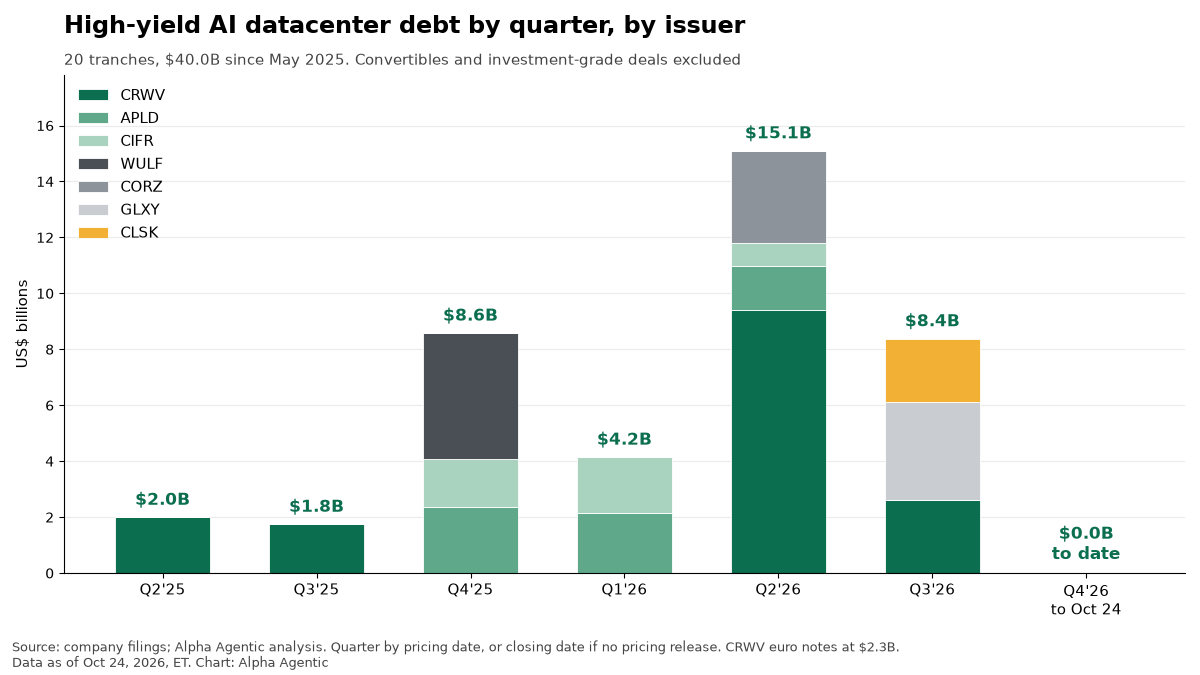
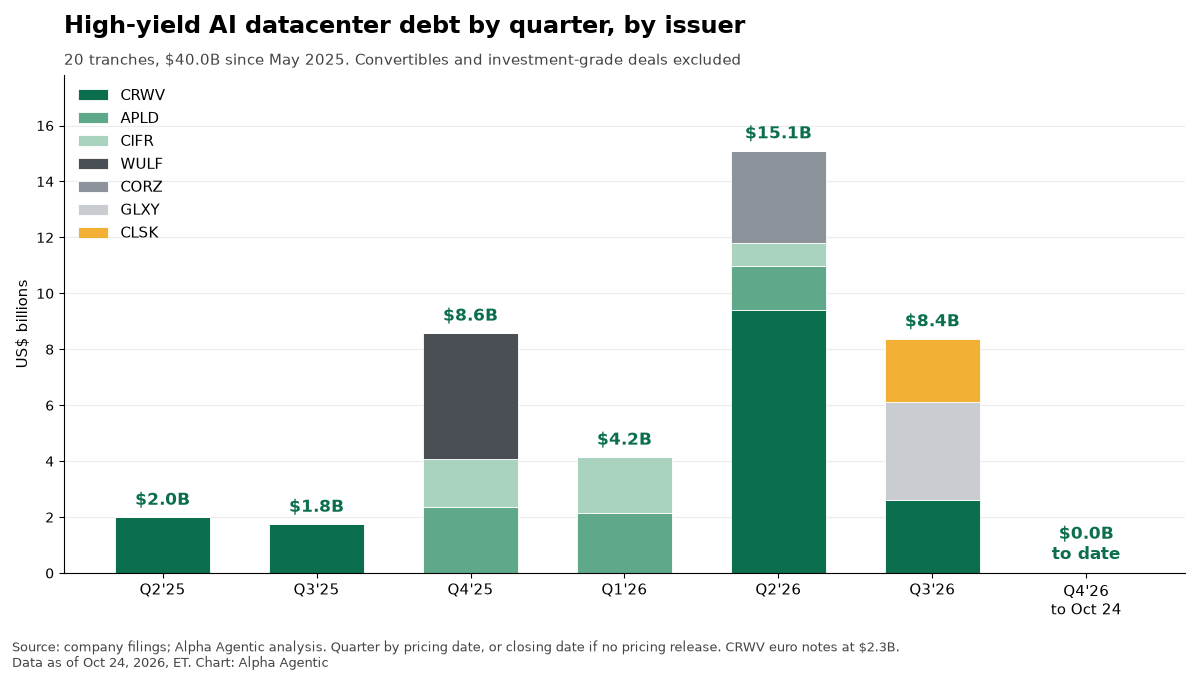
This tracker logs every such deal we can document from primary sources. Since May 2025, we count 20 tranches worth $40.0 billion. Thirteen of them, worth $27.6 billion, priced or closed in 2026. Our thesis: this market has become a core funding channel for AI compute. Its risk sits less in any single bond than in a few shared dependencies: a small set of tenants, GPUs that age faster than the debt, and a maturity wall in 2030 and 2031.
Inclusion rule: A deal is listed if it is debt, not equity-linked, and meets two tests. First, at least one of Moody’s, S&P or Fitch rates it Ba1/BB+ or lower, as disclosed by the company or the agency. An unrated deal qualifies only if it was sold as a high-yield 144A offering. Second, the company’s disclosed use of proceeds goes substantially to AI datacenters or compute. For pure-play AI cloud providers, we count general corporate purpose notes, because the business itself is AI compute. Each tranche gets its own row.
What is excluded: Convertible notes are excluded and noted separately below, because their pricing reflects equity value as much as credit. Investment-grade deals are excluded, as are unrated bank loans and any deal we could find only in news coverage. Excluded deals and the reasons are listed in our sources file.
As of: Oct. 24, 2026. Dates are pricing dates, or closing dates where no pricing release exists. Coupons are at issue. We do not track yields or trading prices.
The tracker
Best viewed on desktop. Swipe the table sideways to see all columns.
| Issuer | Ticker | Date | Amount | Coupon | Maturity | Rating | Use of proceeds | Source |
|---|---|---|---|---|---|---|---|---|
| CleanSpark (CSDC Finance I) | CLSK | Sept. 18, 2026 | $2.276B | 7.875% | 2031 | BB- (Fitch) | Sandersville, Ga., datacenter build; equity reimbursement; reserves | Filing |
| CoreWeave (DDTL 5.5 term loan) | CRWV | Aug. 7, 2026 | $2.6B | SOFR + 5.500% | 2031 | Ba2 (Moody's) / BB+ (Fitch) | GPU infrastructure for customer contracts averaging about 3 years | Filing |
| Galaxy Digital (Galaxy Helios Data Centers II) | GLXY | July 23, 2026 | $3.507B | 9.875% | 2031 | BB- (Fitch) | Helios campus expansion, Dickens County, Texas; reserves | Filing |
| CoreWeave (USD senior notes) | CRWV | June 18, 2026 | $1.25B | 9.625% | 2032 | BB- (Fitch) | General corporate purposes incl. debt repayment | Filing |
| CoreWeave (EUR senior notes, €2.0B) | CRWV | June 18, 2026 | $2.3B | 8.500% | 2032 | BB- (Fitch) | General corporate purposes incl. debt repayment | Filing |
| Applied Digital (APLD ComputeCo 3) | APLD | June 9, 2026 | $1.59B | 7.000% | 2031 | BB- (Fitch) | 150 MW building at Polaris Forge 1, N.D.; repay bridge; reserves | Filing |
| Cipher Digital (Stingray Compute) | CIFR | June 8, 2026 | $810M | 6.000% | 2031 | Ba2 (Moody's) / BB- (Fitch) | Stingray facility build; reimbursement; reserves | Filing |
| CoreWeave (DDTL 5.0 term loan) | CRWV | May 15, 2026 | $3.1B | SOFR + 4.500% | 2031 | Ba2 (Moody's) / BB+ (Fitch) | GPU infrastructure for two customer contracts | Filing |
| Core Scientific (Core Scientific Finance I) | CORZ | April 22, 2026 | $3.3B | 7.750% | 2031 | BB- (Fitch) / BB (S&P) | Four datacenter projects; repay bridge loan; reserves | Filing |
| CoreWeave (senior notes add-on) | CRWV | April 16, 2026 | $1.0B | 9.750% | 2031 | BB- (Fitch) | General corporate purposes | Filing |
| CoreWeave (senior notes) | CRWV | April 14, 2026 | $1.75B | 9.750% | 2031 | BB- (Fitch) | General corporate purposes incl. debt repayment | Filing |
| Applied Digital (APLD ComputeCo 2) | APLD | March 4, 2026 | $2.15B | 6.750% | 2031 | BB category (Fitch) | 200 MW Polaris Forge 2 campus, Harwood, N.D. | Filing |
| Cipher Digital (Black Pearl Compute) | CIFR | Feb. 4, 2026 | $2.0B | 6.125% | 2031 | Ba2 (Moody's) / BB- (Fitch) | Black Pearl facility build, Texas; reimbursement; reserves | Filing |
| TeraWulf (Flash Compute JV) | WULF | Dec. 18, 2025 | $1.3B | 7.250% | 2030 | Ba3 (Moody's) | Abernathy, Texas, HPC campus build; reserves | Filing |
| Cipher Digital (Cipher Compute add-on) | CIFR | Nov. 20, 2025 | $333M | 7.125% | 2030 | Ba3 (Moody's) / BB- (Fitch) | Additional Barber Lake facilities, Texas | Filing |
| Applied Digital (APLD ComputeCo) | APLD | Nov. 13, 2025 | $2.35B | 9.250% | 2030 | BB- (Fitch) | ELN-02 and ELN-03 datacenters, Ellendale, N.D.; refinance; reserves | Filing |
| Cipher Digital (Cipher Compute) | CIFR | Nov. 5, 2025 | $1.4B | 7.125% | 2030 | Ba3 (Moody's) / BB- (Fitch) | Barber Lake facility build, Texas | Filing |
| TeraWulf (WULF Compute) | WULF | Oct. 16, 2025 | $3.2B | 7.750% | 2030 | Ba2 (Moody's) / BB (S&P) / BB (Fitch) | Lake Mariner campus expansion, N.Y. | Filing |
| CoreWeave (senior notes) | CRWV | July 22, 2025 | $1.75B | 9.000% | 2031 | BB- (Fitch) | General corporate purposes | Filing |
| CoreWeave (senior notes) | CRWV | May 21, 2025 | $2.0B | 9.250% | 2030 | BB- (Fitch) | General corporate purposes incl. debt repayment | Filing |
Totals: 20 tranches, $40.0B. 2025: 7 tranches, $12.3B; 2026: 13 tranches, $27.6B. 2024: none qualified. Euro tranche counted at $2.3B.
Convertibles, listed separately: The same issuers have leaned hard on convertible notes. CoreWeave (NASDAQ: CRWV) alone has priced three convertible issues since December 2025, most recently $3.7 billion of 2.875% notes due 2033 in September. Cipher Digital (NASDAQ: CIFR), TeraWulf (NASDAQ: WULF), Core Scientific (NASDAQ: CORZ), CleanSpark (NASDAQ: CLSK) and Applied Digital (NASDAQ: APLD) have also sold convertibles. These are outside the table, and the sources file lists the ones we checked.
What the deals tell investors
Two kinds of paper: The table holds two different credit stories. CoreWeave’s eight tranches total $15.75 billion, or 39% of the tracker. Six are unsecured corporate notes with coupons of 8.500% to 9.750%, backed by the whole company. The other 12 tranches, worth $24.2 billion, are secured notes issued by single-purpose subsidiaries. Each is tied to one campus, carries a debt service reserve, and has coupons of 6.000% to 9.875%.
Pricing: Coupons at issue vary more by structure than by date. Cipher Digital priced its Stingray notes at 6.000% in June 2026. Six weeks later, Galaxy Digital (NASDAQ: GLXY) priced its Helios II notes at 9.875%. For contrast, Hut 8 (NASDAQ: HUT) sold investment-grade project notes at 6.129% due 2042. The best junk deals now price near investment-grade coupons, though at much shorter maturities.
Refinancing wall: About 91% of the dollars in the table come due in 2030 or 2031. That is $36.4 billion, by our calculation. Some project notes amortize, which shrinks the wall. Galaxy’s notes, for example, amortize 4% a year after an initial period. Most of the balance will still need refinancing or repayment from lease cash flow.
Contract term vs. debt term: CoreWeave’s DDTL 5.5 loan runs about five years. The customer contracts behind it average about three years, the company said. That gap is a bet that customers renew or new ones replace them. Earlier CoreWeave loans were matched to contracts that ran through the debt’s maturity.
Customer concentration: A few counterparties stand behind many deals. Fluidstack is linked to $6.2 billion of the table, by our count. TeraWulf’s WULF Compute notes and Cipher’s Cipher Compute notes are secured in part by Fluidstack lockbox accounts. Before construction is complete, they are also backed by a pledge of Google warrants. Fluidstack also owns 49.9% of TeraWulf’s Flash Compute joint venture.
Rates: Most of the table is fixed-rate debt. The two CoreWeave term loans, $5.7 billion in total, float over SOFR. Higher short-term rates would raise their cost directly.
Hyperscaler link: These bonds are a bet on the spending plans in our Hyperscaler Capex Tracker. Rent paid by big tech and AI labs is the cash that services this debt. If capex guidance is cut, the deals with short or non-investment-grade contracts would feel it first.
The Alpha Take
The bull case: This is not 1999-style vendor finance. Most of the debt is secured by specific campuses, much of it tied to long-term leases. Many deals carry reserves and completion guarantees. Two carry pledges of Google warrants until construction ends. Rating agencies have been willing to rate project notes in the BB range. Fitch has a positive outlook on CoreWeave. On this view, the coupons are generous for credits that will improve as campuses finish and cash flows begin.
The bear case: The collateral ages fast. GPUs and their cooling systems can lose value well before 2031. Counterparties are concentrated, and the largest issuer, CoreWeave, is itself a high-yield credit. Then there is xAI. It sold $3.0 billion of 12.5% secured notes in 2025. The debt was repaid in March 2026 with a $518 million prepayment penalty, according to SpaceX (NASDAQ: SPCX) filings. That cost shows how expensive this kind of debt can get at the riskier end.
Our view: Both cases are partly right, and the split runs through the table. Project notes with completed buildings and investment-grade tenants look like infrastructure debt priced at a premium. Unsecured notes and loans backed by short contracts carry real technology risk. Investors should know which one they own. The bigger risk is shared: almost all of this debt depends on hyperscaler and AI lab spending continuing through 2030. A slowdown would hit many of these bonds at once.
What to watch
- New issuance: Q4 2026 has no qualifying deals in the tracker yet. A quiet quarter after $15.1 billion in Q2 would be a signal in itself.
- Rating moves: Fitch has positive outlooks on CoreWeave and APLD ComputeCo 3. Upgrades could move more deals toward investment grade, where Hut 8’s project notes priced.
- Construction milestones: Many issuers’ notes are secured by campuses still being built. Delays could draw down reserves.
- Contract renewals: Watch whether CoreWeave’s roughly three-year contracts behind DDTL 5.5 renew before the loan matures in 2031.
- Hyperscaler guidance: The rest of the Q3 2026 capex reports set the demand outlook that underpins every row in this table.
This tracker is for information only and is not investment advice. Figures come from company filings and rating agency disclosures listed in our sources file.