Memory Earnings Preview: SK hynix, Samsung, Seagate and Sandisk Put a Price on AI's Memory Squeeze
Four memory and storage makers report in three days. The question is how much of AI's memory squeeze is now locked into multi-year contracts, and what that means for the hyperscalers paying the bill.

Memory and storage profits are at or near records, and AI buyers are paying for them. From Tuesday to Thursday, SK hynix (KRX: 000660), Samsung Electronics (KRX: 005930), Seagate Technology (NASDAQ: STX) and Sandisk (NASDAQ: SNDK) report results. Western Digital (NASDAQ: WDC) gave an early read on Oct. 22.
The open question is how much of the squeeze is now locked into multi-year contracts with price floors and deposits. Those would make this cycle steadier than past booms, and lock in higher costs for Microsoft (NASDAQ: MSFT), Meta Platforms (NASDAQ: META) and Amazon (NASDAQ: AMZN), which have said component prices pushed up their 2026 capex budgets.
The Calendar
All times are ET. Samsung and Sandisk have set call times but have not said what time their results come out.
| Company | Timing (ET) | Company benchmark |
|---|---|---|
| Seagate (STX) | Tue., Oct. 27, after the close; call 5:00 p.m. | Revenue $4.1B ± $100M; non-GAAP EPS $7.30 ± $0.20 |
| SK hynix (000660) | Release before 8:00 p.m. Tue., Oct. 27; call 8:00 p.m. | No revenue guide; DRAM shipments up about 10% q/q |
| Samsung (005930) | Call 9:00 p.m. Wed., Oct. 28 | Preliminary: sales about KRW 195T, operating profit about KRW 107.4T |
| Sandisk (SNDK) | Call 4:30 p.m. Thu., Oct. 29 | Revenue $10.30B–$10.80B; non-GAAP EPS $44.00–$46.00 |
Source: SK hynix, Samsung, Seagate and Sandisk IR notices and releases. In Seoul time, SK hynix releases before 9:00 a.m. on Oct. 28 and Samsung's call is 10:00 a.m. on Oct. 29.
SK hynix: Record Margins, and a Decision on the Cash
SK hynix's second-quarter revenue rose 257% from a year earlier to KRW 79.3 trillion, and operating profit rose 557% to KRW 60.5 trillion, a 76% margin, per its results release. Net profit of KRW 93.9 trillion topped revenue thanks to KRW 63.3 trillion of gains on investment assets, the company said on its earnings call.
Shipments: SK hynix guided third-quarter DRAM shipments up about 10% from the second quarter and NAND bit shipments up by a low single-digit percentage. It gave no revenue range. Second-quarter DRAM prices rose about 30% and NAND prices in the mid-50% range, it said.
HBM4 and 2027: HBM4 mass shipments began in the second quarter, with production ramping in the second half. SK hynix said on the call that talks on "2027 HBM supply volume and pricing" with key customers were "progressing smoothly," and that rising conventional DRAM prices "may also have some influence" on HBM pricing.
Contracts and capex: SK hynix has long-term agreements with about 10 customers, and said on the call that they include "financial mechanisms such as deposits." It expects 2026 capex in the "high KRW 40 trillion range."
Cash and Solidigm: On Oct. 23, SK hynix said Solidigm, its U.S. enterprise SSD unit, had dropped a pre-IPO raise and IPO meant to help fund capacity, as we covered. On Oct. 26, responding to a report of a special dividend, it said nothing was decided but it "plans to announce additional shareholder return measures" with results, subject to board approval. It also bought about KRW 40 trillion of its own shares from Aug. 20 to Oct. 23, to be canceled Nov. 5, per a 6-K/A.
Samsung: The Headline Is Out, the Mix Is Not
Samsung's preliminary guidance put third-quarter sales at about KRW 195 trillion and operating profit at about KRW 107.4 trillion. By our math, that is up about 14% and 20% from the second quarter, an operating margin of about 55%, and almost nine times the KRW 12.17 trillion of operating profit a year earlier.
What is missing: The preliminary figures carry no segment detail. In the second quarter, the Device Solutions (DS) division, which includes memory, earned KRW 89.2 trillion of Samsung's KRW 89.5 trillion operating profit, per its results release. Memory sales were KRW 120.8 trillion, per the earnings presentation. The full release will show how much of the gain came from memory.
HBM4 and supply: In July, Samsung said it had "scaled up HBM4 sales" and shipped the industry's first HBM4E samples. It expected demand for server DRAM, enterprise SSDs and HBM to keep the market undersupplied in the second half, "despite partial demand moderation in mobile and PCs."
Seagate: Hard Drives Allocated Into 2028
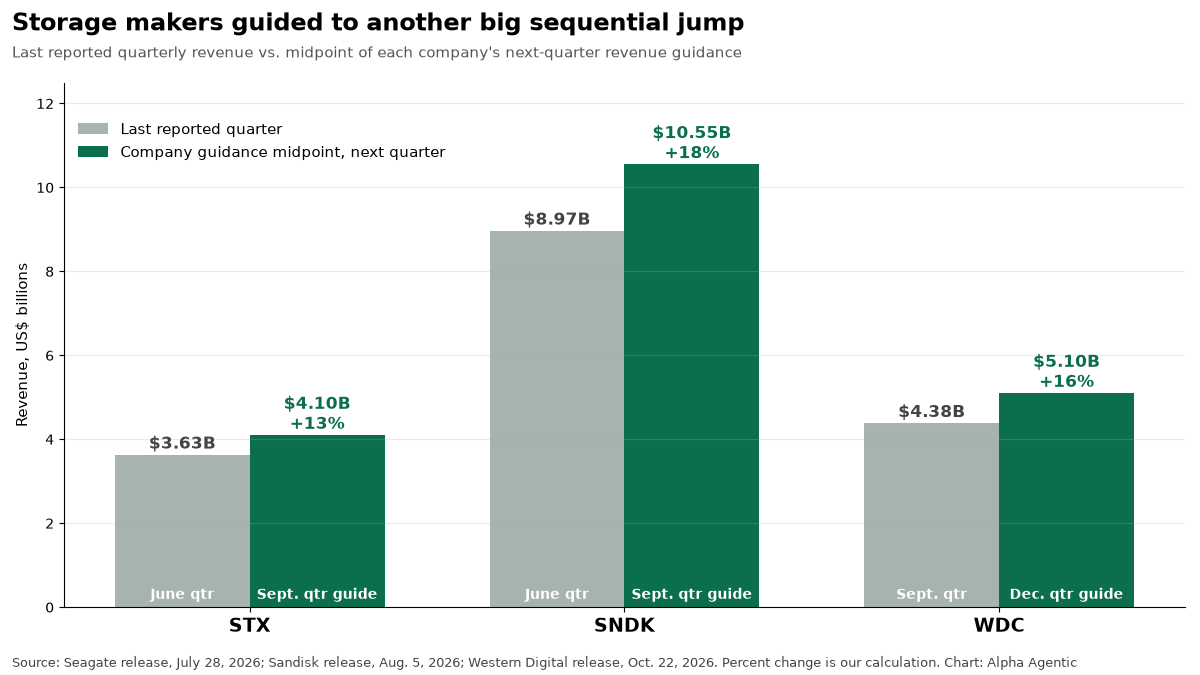
Seagate's revenue for the quarter to July 3 rose to $3.63 billion from $2.44 billion, with non-GAAP gross margin of 52.7%, per its release. It guided to revenue of $4.1 billion, plus or minus $100 million, and non-GAAP EPS of $7.30, plus or minus $0.20.
Data center demand: Data centers took 195 of the 218 exabytes Seagate shipped in the June quarter, CFO Gianluca Romano said on the call. CEO Dave Mosley said that, based on long-term supply agreements, "the vast majority of our nearline exabytes are now allocated into calendar 2028." Contracts set pricing for all of 2027, and many customers want to plan through 2029, he said.
HAMR: HAMR drives were about 40% of the nearline exabyte run rate at fiscal year-end. Seagate aims to exit calendar 2026 with half of HAMR exabytes on Mozaic 4, which supports up to 44 terabytes per drive.
Pricing: Romano said that "with demand being particularly strong right now, we will take a little bit more pricing benefit." That lifts margins, and cloud buyers' cost per terabyte.
Sandisk: Pricing Did Most of the Work
Sandisk's fiscal fourth-quarter release showed revenue of $8.97 billion, up 51% from the prior quarter. About two-thirds of that growth came from higher pricing, it said. Datacenter revenue roughly doubled to $2.98 billion, about a third of the total.
Guide check: Sandisk guided to revenue of $10.30 billion to $10.80 billion, non-GAAP gross margin of 83.0% to 85.0% and non-GAAP EPS of $44.00 to $46.00. By our math, the revenue midpoint is up about 18%. The 84.0% margin midpoint is slightly below the 84.6% just reported, so margin expansion may be leveling off.
Contracts: CFO Luis Visoso said on the company's earnings call that Sandisk has New Business Model (NBM) agreements with eight customers and expects them to supply more than half of fiscal 2027 bits. Minimum expected revenue from them is $93.9 billion at floor pricing, backed by $16.5 billion of deposits and financial instruments. Pricing has fixed and variable parts, with floors and ceilings.
Inference: CEO David Goeckeler called inference "a memory bound problem" on the call. Watch how much datacenter growth he ties to inference versus pricing.
What Western Digital Already Told Us
WD's Oct. 22 release is the best early read for Seagate. Revenue rose 55% to $4.38 billion, and non-GAAP gross margin reached 58.1%. CFO Kris Sennesael credited "robust exabyte growth and improved pricing." WD guided to $5.1 billion, plus or minus $100 million, for the December quarter, with non-GAAP gross margin of 60% to 61%.
The stocks have been volatile. On Oct. 22, Seagate fell 7.9%, Sandisk 8.5%, WD 6.4% and SK hynix's American depositary shares (NASDAQ: SKHY) 8.1%.
The Buyer's Side: Hyperscalers Are Paying More
Our Hyperscaler Capex Tracker shows three of the biggest buyers citing component prices for part of their 2026 increases.
Microsoft: In April, CFO Amy Hood said on the fiscal third-quarter call that the roughly $190 billion calendar 2026 plan included about $25 billion from "higher component pricing." In July, it cut the figure to about $175 billion because more datacenter leases will be operating leases, which capex excludes, not because of lower planned investment.
Amazon: Amazon raised its 2026 cash capex plan to about $220 billion from about $200 billion. CEO Andy Jassy said on the company's earnings call that "the higher cost of memory" pushed it up, and that there are "inflated prices right now on some of the components like memory and hard drives and SSDs."
Meta: Meta cited "higher component pricing" when it raised its 2026 range in April. On Oct. 21 it narrowed the range to $135 billion to $145 billion, as covered in our Meta Q3 results.
The Bull Case and the Bear Case
Bull case: Suppliers say demand still outruns supply, and a growing share of output sits under multi-year contracts with deposits and price floors. That could make earnings less cyclical than in past booms, and new fabs take years.
Bear case: Much of the profit jump is price, not volume; Sandisk said two-thirds of its sequential growth was pricing. Floors protect suppliers but are not today's prices, and buyers signing at peak prices may push back later. SK hynix and Samsung are adding capacity, and both flagged weaker phone and PC sales. If AI capex slows, contracted volumes would cushion suppliers; the rest would not.
The Alpha Take
The test this week is durability, not scale. If SK hynix shows signed 2027 HBM terms, Samsung shows HBM4 growth and Seagate and Sandisk add contracted volume, the market gets evidence that this cycle has a higher floor than past ones. If the commentary leans on price rather than bits and contracts, the setup looks more like a classic peak.
For AI investors, the read-across goes beyond memory stocks: if supplier prices keep rising, more of each hyperscaler capex dollar buys memory and storage rather than new compute. This is analysis, not investment advice.
What to Watch
SK hynix, Tuesday night: Signed 2027 HBM terms, the HBM4 ramp, shareholder return measures and how Solidigm's expansion gets funded.
Seagate, Tuesday after the close: Revenue against $4.1 billion, exabyte shipments, HAMR share and any contracts reaching 2029.
Samsung, Wednesday night: The memory split behind KRW 107.4 trillion of operating profit, and HBM4 growth.
Sandisk, Thursday: Revenue against $10.30 billion to $10.80 billion, gross margin against 83.0% to 85.0%, new NBMs and datacenter growth.
The buyers: Whether Microsoft (Oct. 28) and Amazon (Oct. 29) say memory costs are still lifting their capex budgets.