Daily Brief: ABB Data Center Orders More Than Double, U.S. Chips Bounce
AI demand showed up in hard orders as ABB's data center bookings more than doubled, while U.S. chips bounced and Seoul slid.
AI demand showed up in hard orders Tuesday, as ABB said its data center bookings more than doubled. Financing worries linger: U.S. chip stocks bounced Monday, but Seoul's chipmakers fell again and an AI cloud IPO sank 32% on its debut.
ABB's data center orders more than double, lifting group orders to a record
ABB (SIX: ABBN) said third-quarter orders rose 40% to a record $12.06 billion, citing a "triple-digit increase" in data center orders, while revenue rose 14% to $9.70 billion. Revenue came in slightly below consensus, and ABB nudged its full-year growth outlook up to the "low teens."
What It Means for Investors: With orders running 1.24 times revenue, power-equipment suppliers could carry larger backlogs into 2027. But ABB does not expect its capex, now around $1 billion, to rise further in the mid-term, so factory capacity could limit how fast orders become revenue.
Source: ABB · Reuters via Euronext
Chip index snaps an eight-session losing streak
The Philadelphia Semiconductor Index (SOX) rose 1.6% Monday, ending an eight-session slide in which it lost 15.7%. Amazon (NASDAQ: AMZN) jumped 5% after Morgan Stanley (NYSE: MS) named it a top pick and Amazon unveiled TorchNeuron, a free tool that runs PyTorch code on Trainium chips, which Reuters said aims to erode Nvidia's (NASDAQ: NVDA) software edge. CoreWeave (NASDAQ: CRWV) slipped 0.4% despite a Goldman Sachs (NYSE: GS) upgrade, and the 10-year Treasury yield rose to 5.15%.
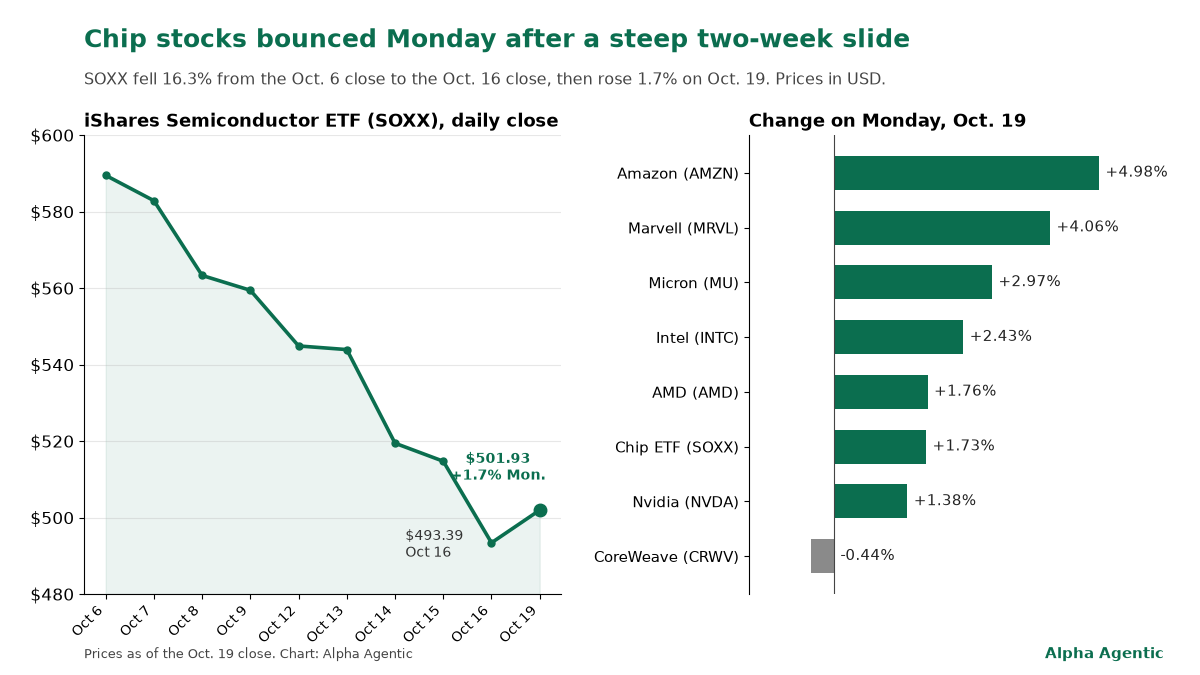
What It Means for Investors: If the bounce was mainly oversold buying, as a Rosenblatt trader told Reuters, it could fade unless this week's earnings show AI spending holding up. A 10-year yield above 5% could keep debt-funded builders under more pressure than cash-rich hyperscalers.
Source: Reuters via Investing.com · Reuters via Investing.com · CNBC
Seoul's chipmakers slide again as AI cloud IPO sinks 32%
South Korea's KOSPI fell 3.73% Tuesday, as Samsung Electronics (KRX: 005930) fell 2.98% and SK Hynix (KRX: 000660) lost 4.23%. SK Group shares also fell after the head of the Financial Supervisory Service said regulators consider a possible U.S. listing of SK Hynix's Solidigm unit to run afoul of dual-listing rules. AI cloud operator Elice (KOSDAQ: 0158S0) closed 32% below its IPO price, at 61,500 won, in its KOSDAQ debut, despite institutional orders for 388.84 times the shares offered.
What It Means for Investors: If new AI cloud listings keep trading below their offer prices, data center developers could face lower valuations or delays. Firmus, AirTrunk and SB Energy have already shelved IPO plans this month.
Source: Korea JoongAng Daily · Seoul Economic Daily · CNBC
Report: Nscale in talks on a second $45 billion Anthropic deal
Nscale is in talks to sell Anthropic about $45 billion more of computing power from a second building at its West Virginia campus, a source told Reuters, after Bloomberg first reported the talks. The building would deliver 460 MW on Nvidia's Vera Rubin chips, the source said. The talks follow Microsoft's (NASDAQ: MSFT) exit from Nscale's flagship Essex site over power-connection delays.
What It Means for Investors: If signed, the deal would make Nscale more dependent on one customer as it prepares to go public, tying its valuation more closely to Anthropic's ability to pay for compute.
Source: Reuters via Investing.com
Amazon funds an Indiana nuclear plan as a report details its power crunch
American Electric Power (NASDAQ: AEP) and X-energy (NASDAQ: XE) will study a 960 MW small modular reactor plant at a former Indiana coal site, with Amazon funding development and intending to buy the power under a long-term contract. No final investment decision has been made. Some AWS sites had room for Nvidia GB300 racks but not enough power to run them, so racks were staged in warehouses, people familiar with the effort told Business Insider. Amazon called such staging "best business practice."
What It Means for Investors: If power rather than chips sets the pace, hyperscalers could tie up more cash in idle hardware, while utilities with customer-funded plants could add generation with less balance-sheet risk.
Source: AEP · Amazon · Business Insider
What to Watch Today
- 8:00 a.m. ET: Power-module maker Vicor (NASDAQ: VICR) holds its call after third-quarter revenue rose 37.5% from the prior quarter to $197.1 million, topping its guidance for more than 30% growth; backlog reached $406 million, up from $153 million a year earlier.
- 8:30 a.m. ET: September housing starts are due, after August's 1.275 million annual rate.
- All day: Nvidia's GTC Berlin opens; Jensen Huang's keynote is Wednesday at 5 a.m. ET.
- After the close: SpaceX (NASDAQ: SPCX) posts third-quarter results, with a webcast at 4:30 p.m. ET.