Intel Q3 2026 Results: Data Center Up 78%, Foundry Loss Narrows, Q4 2026 Margin Guide Falls to 38%
Intel's data center revenue rose 78% and its foundry loss narrowed in Q3 2026. Intel then guided Q4 2026 below the quarter just reported, citing weaker PC demand and an accident at its fab in Israel.
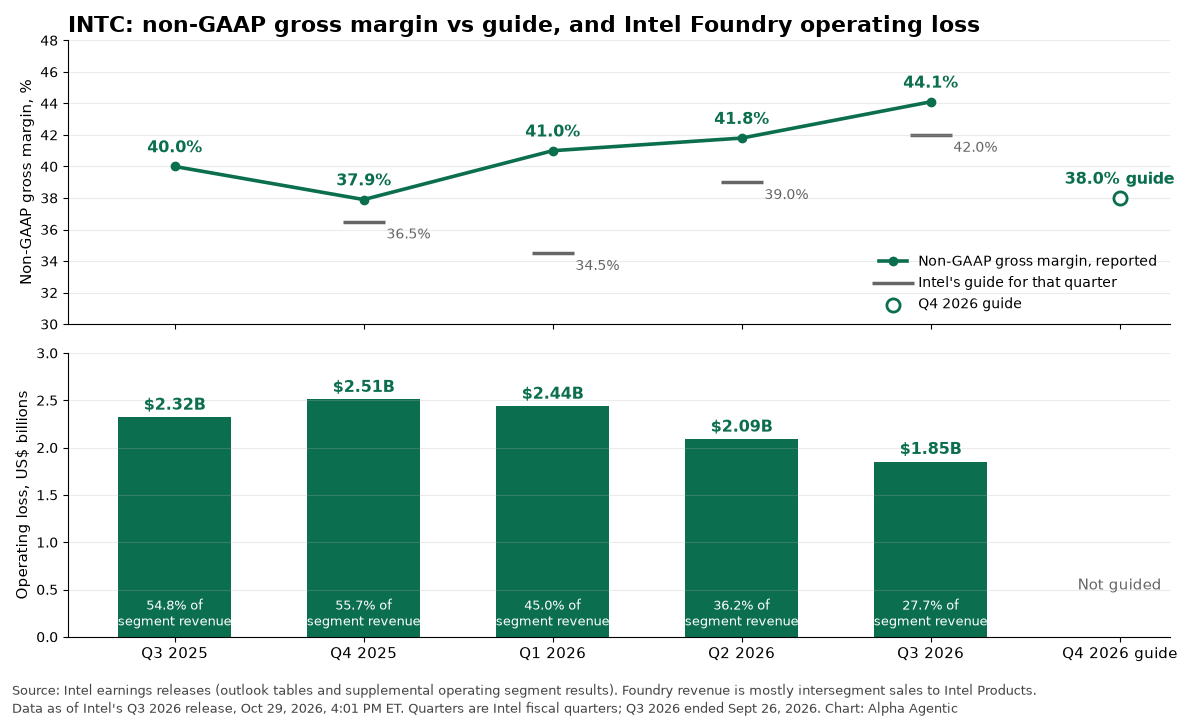
Intel (NASDAQ: INTC) reported results for Q3 2026, the quarter that ended Sept. 26, 2026, after the market closed on Oct. 29. Revenue, gross margin and earnings per share all came in above the guide Intel gave with its Q2 2026 results. The outlook went the other way. Intel guided Q4 2026 revenue below the quarter it had just reported and guided its non-GAAP gross margin to 38.0%, down from 44.1%. It said the guide includes about $300 million of revenue and 2 points of margin from an accident at its fab in Israel. The Form 10-Q, released with the results, still names no outside foundry customer.
Intel shares closed at $65.76 on Oct. 30, down 28.6% from $92.07 on Oct. 29. That is 30.8% below the $95 price of Intel's stock sale in Q3 2026, by our math.
Key numbers
Non-GAAP gross margin: 44.1% in Q3 2026, against a 42.0% guide and 40.0% in Q3 2025.
Revenue: $16.5 billion in Q3 2026, up 21% from Q3 2025 and $0.2 billion above the guide midpoint.
DCAI revenue: $7.3 billion in Q3 2026, up 78% from Q3 2025.
Intel Foundry operating loss: $1.9 billion in Q3 2026, against $2.1 billion in Q2 2026.
Diluted share count: 5,307 million in Q3 2026, up 17.1% from 4,531 million in Q3 2025.
Q4 2026 guide: a 38.0% non-GAAP gross margin, 6.1 points below Q3 2026.
Graded Against Our Preview
Intel beat five of the eleven benchmarks in our preview for Q3 2026, met one, improved on two and fell short on three.
Our earnings preview took its bars from the guide Intel gave with its Q2 2026 results and Q2 2026 levels.
| Benchmark | Preview bar (Q3 2026) | Actual (Q3 2026) | Result |
|---|---|---|---|
| Revenue | $15.8B to $16.8B | $16.5B | Beat the midpoint by $0.2B |
| Non-GAAP gross margin | 42.0% | 44.1% | Beat by 2.1 points |
| Non-GAAP EPS | $0.38 | $0.52 | Beat by $0.14 |
| GAAP EPS | $0.31 | $0.60 | Beat; includes a $0.17 gain on escrowed shares |
| DCAI growth | Above Q2 2026's 59% | 78% | Beat |
| Foundry operating loss | Q2 2026: $2.1B | $1.9B | Narrowed by $236M |
| External foundry revenue | Q2 2026: $293M | $411M | Higher, primarily one non-recurring contract |
| Named 14A customer | Any named | None named | Not met |
| 14A PDK 0.9 | Due in October | Released in October | Met |
| 2026 capex | Above "more than $20B" | "On track to be $20 billion" | Not raised |
| Q4 2026 revenue guide | Higher, if supply allowed | $15.0B to $16.0B | Lower than Q3 2026 |
Source: Intel's Q3 2026 earnings release, CEO and CFO prepared remarks and the Q3 2026 10-Q. Beat margins are our math.
CFO Dave Zinsner said in his prepared remarks that this was the eighth consecutive quarter of exceeding Intel's financial expectations. Adjusted free cash flow, Intel's own measure, was $1.6 billion, against $0.9 billion a year earlier, per the release.
Server CPUs: Demand Still Ahead of Output
Intel's DCAI (Data Center and AI) segment had revenue of $7.3 billion in Q3 2026, up 78% from a year earlier and 17% from Q2 2026, with operating income of $3.0 billion.
Output: Zinsner said strong factory and supply-chain execution "drove better-than-expected server CPU output," while demand "continues to meaningfully exceed available supply." The 10-Q credits "a higher mix of premium products," with "demand-based pricing actions" contributing "to a lesser extent." He now expects industry server CPU units to grow more than 30% in both 2026 and 2027. Our Hyperscaler Capex Tracker follows the spending behind that demand.
Roadmap: CEO Lip-Bu Tan said Clearwater Forest, the first 18A server chip, is shipping for revenue. Diamond Rapids, which Oracle (NYSE: ORCL) plans to use in its cloud offerings, is on track to ramp in 2027.
Limits: Tan cited Intel 3 yields and a shortage of packaging substrates. He said the Israel accident "will impact our Q4 10nm server shipments."
PCs: Client revenue fell 9% from Q2 2026 to $8.1 billion. Intel now expects industry PC units to fall about 12% in 2026 and is planning for a decline of roughly 10% in 2027.
Foundry: Loss Narrows to $1.9 Billion
Intel Foundry lost $1.9 billion on $6.7 billion of revenue in Q3 2026, the smallest loss of the last five quarters.
| Quarter | Foundry revenue, $M | Operating loss, $M | Loss / foundry revenue (our math) |
|---|---|---|---|
| Year ago (Q3 2025) | 4,235 | (2,321) | 54.8% |
| Q4 2025 | 4,507 | (2,509) | 55.7% |
| Q1 2026 | 5,421 | (2,437) | 45.0% |
| Last quarter (Q2 2026) | 5,765 | (2,089) | 36.2% |
| This quarter (Q3 2026) | 6,697 | (1,853) | 27.7% |
Source: Intel's supplemental operating segment tables in its Q3 2025 to Q3 2026 earnings releases, as reported. Ratios are Alpha Agentic calculations; steps are in our sources file.
Our math: The foundry loss equaled 11.2% of Intel's total revenue in Q3 2026, down from 17.0% a year earlier. Outside customers supplied 6.1% of foundry revenue, up from 5.1% in Q2 2026.
Why it narrowed: The 10-Q cites $793 million of lower period charges. Zinsner said Intel 18A costs have declined about 40% since Q1 2026, but that Intel has "considerable work ahead" to make foundry "sustainably profitable."

What the 10-Q Says About Customers, Ireland and Commitments
Intel's Q3 2026 10-Q, released with results on Oct. 29, names no external foundry customer and says outside foundry revenue of $411 million came "primarily" from "a non-recurring foundry contract."
Customers: Our preview found no disclosed foundry customers, and that has not changed. The filing says "substantially all" of Intel Foundry still serves Intel's own products. Tan said Intel will "not disclose customer details." He described "a couple of highly strategic customers" for 18A-P and "multiple potential customers" for 14A. The 10-Q still ties 14A expansion to "committed demand."
Ireland: Intel has owned all of its Ireland fab venture since buying back Apollo Global Management's (NYSE: APO) 49% stake on April 8. The related agreements are "substantially terminated," and the venture booked no minority-holder income in Q3 2026, against $69 million a year earlier. Brookfield still owns 49% of the Arizona venture, where Intel must run at minimum production levels or pay damages.
Commitments: Capital spending commitments were $19.6 billion at Sept. 26, and other purchase obligations were $9.8 billion. That is $29.4 billion combined, up 51% from Dec. 27, 2025, by our math. After the quarter, Intel signed two substrate deals worth an estimated $5.3 billion to $6.1 billion.
Israel: The 10-Q says that in mid-October 2026, "an accident at our manufacturing facility in Kiryat Gat, Israel resulted in employee casualties and injuries and halted manufacturing operations at the facility." It says operations were expected to resume by the end of October 2026. Intel expects the stoppage to hurt manufacturing costs, gross profit and operating results in Q4 2026 and through the first half of 2027, but says it is "currently unable to reasonably estimate the financial impact" or any insurance recovery.
Share Count: The Stock Sale in the EPS Line
Intel's diluted share count averaged 5,307 million in Q3 2026, up 17.1% from a year earlier, after it issued 242.1 million shares at $95 in a stock sale that closed on Aug. 12.
Shares outstanding rose 267 million in the quarter, to 5,310 million; the offering is 91% of that, by our math. The new stock was outstanding for 46 of the quarter's 91 days, so about 122 million of it, time-weighted, sat in the Q3 2026 average, by our estimate. Intel guides to 5.44 billion diluted shares in Q4 2026, a full quarter of the offering and 2.5% above the Q3 2026 average. Zinsner said interest on the proceeds added about one cent to Q3 2026 EPS. We do not estimate any other per-share effect.
What Changed: The Q4 2026 Guide
Intel guided Q4 2026 revenue to $15.0 billion to $16.0 billion, with a 38.0% non-GAAP gross margin and $0.25 of non-GAAP EPS at the $15.5 billion midpoint.
| Metric | Year ago (Q4 2025) | This quarter (Q3 2026) | Company guide (Q4 2026) |
|---|---|---|---|
| Revenue | $13.7B | $16.5B | $15.0B to $16.0B |
| Non-GAAP gross margin | 37.9% | 44.1% | 38.0% |
| Non-GAAP EPS | $0.15 | $0.52 | $0.25 |
| Diluted shares | 4,856M | 5,307M | 5.44B |
Source: Intel's Q4 2025 and Q3 2026 earnings releases and Q3 2026 prepared remarks. Margin and EPS guides assume the revenue midpoint. The year-ago column is the year-ago period for the guided quarter; Q4 2025 shares are the weighted average for a GAAP loss quarter.
The midpoint is 6.1% below Q3 2026. Intel says the guide includes about $300 million of revenue and 200 basis points of margin from the Fab 28 accident, almost all of the revenue in 10nm server products. Adding those back gives about $15.8 billion and 40.0%, by our math, still below Q3 2026. Zinsner tied the margin drop mainly to lower revenue "against our fixed-cost base" as Intel adjusts client wafer starts, plus product mix. He expects DCAI to grow by a mid-teens percentage from Q3 2026 while client revenue falls more than 20%.
The Alpha Take
Our preview called Q3 2026 a supply test. Intel passed it: DCAI growth sped up, and gross margin beat the guide by 2.1 points. The problem is the next quarter.
What we got right: We argued that output, not demand, would set server revenue. Zinsner's remarks support that: output beat Intel's expectations while demand still exceeded supply, and DCAI beat. We also flagged that the stock sale enters the share count in stages; the 5.44 billion Q4 2026 guide shows the full effect is still ahead.
What we got wrong: We gave PCs one line. Client revenue, a larger segment than DCAI, is now the main drag on the Q4 2026 guide. We also framed the Q4 2026 guide as a question of whether supply would allow more. Instead it came in lower, on PC demand and a mid-October fab accident. That accident was public before our preview ran, and we did not mention it. And we used external foundry revenue as a gauge of outside demand. The Q3 2026 rise came mostly from a one-time contract.
The margin math: Gross margin rose 4.1 points in a year, then the guide gives back 6.1 points in one quarter. Only about 2 points of that is Fab 28. Intel ties most of the rest to lower revenue on fixed factory costs. If that holds, the margin would depend on PC volumes as much as on 18A yields, and about 40% before Fab 28, by our math, is the cleaner comparison with 44.1%.
The foundry ratio: The loss ratio fell from 55% to 28% in a year. But most foundry revenue is Intel buying from itself, at prices meant to approximate the market. If lower client wafer starts slow that progress, the ratio says more about Intel's own volumes than outside demand.
What Q4 2026 has to show: DCAI growth near the mid-teens despite lost 10nm server output, a margin at or above 38% once Fab 28 charges are booked, and evidence that $29.4 billion of commitments, plus the substrate deals, rest on demand Intel can name. This is analysis, not investment advice.
What to Watch
Intel's next report covers Q4 2026; the company has not announced a date.
DCAI against mid-teens growth: Server output after the Fab 28 shutdown.
Gross margin against 38.0%: The size of Fab 28 charges and any insurance recovery.
Foundry loss against $1.9 billion: Whether it keeps narrowing as client wafer starts fall.
Customers and capex: Any named 18A-P or 14A customer, a 2027 capex figure, and year-end purchase commitments.
Read-across: Advanced Micro Devices (NASDAQ: AMD) posts its results on Nov. 3. Its server and PC comments will test both halves of Intel's outlook.