Neocloud Economics: What CoreWeave, Nebius and IREN Earn per Megawatt, and What They Owe
Neoclouds borrow against contracts to buy GPUs. From filings, we measure revenue and debt per megawatt and what a shorter GPU life would do to earnings.
Q3 2026 update: CoreWeave reported Q3 2026 results on Nov. 10. Read our CoreWeave Q3 2026 results breakdown.
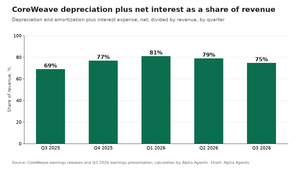
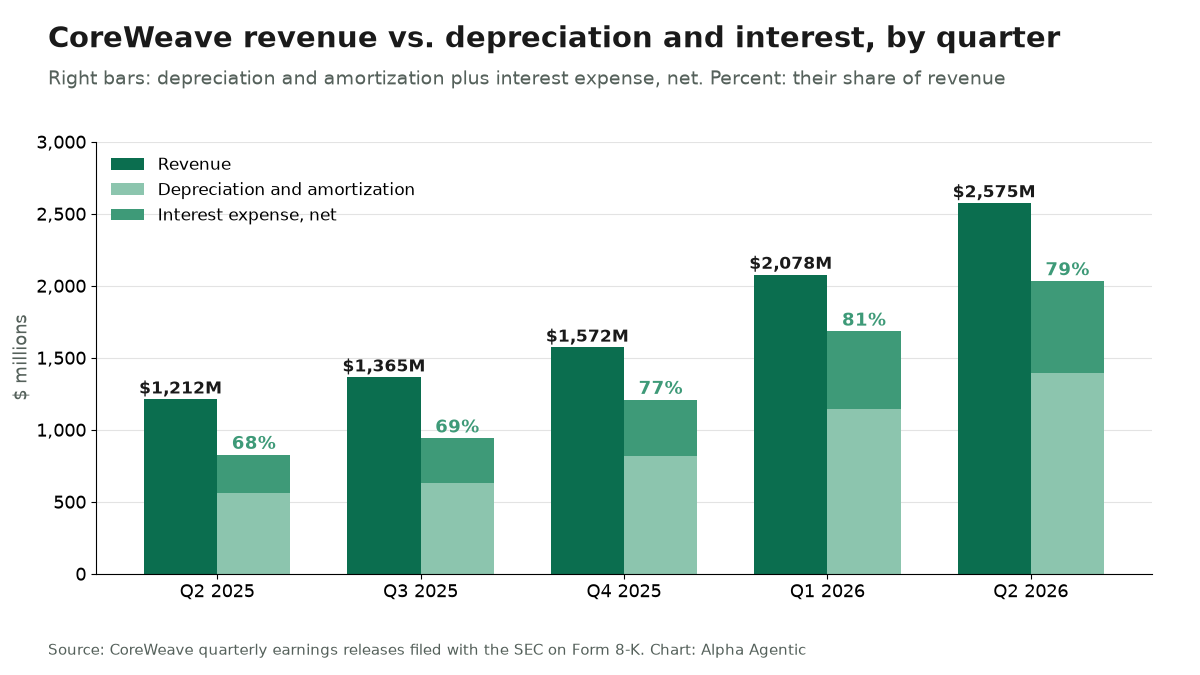
Neoclouds turn debt into GPU revenue by borrowing against contracts that hyperscalers and AI labs have already signed. The model works when the chips earn back their cost before the contracts end and before the debt comes due. On the filings, that margin of safety is thinner than the backlog headlines suggest. At CoreWeave (NASDAQ: CRWV), depreciation, amortization and net interest absorbed 79% of second-quarter 2026 revenue, up from 68% a year earlier, by our math. Nebius (NASDAQ: NBIS) added a year to its server lives in 2026, which cut second-quarter depreciation by $43.0 million. IREN (NASDAQ: IREN) is earlier in the cycle, with $10.2 billion of debt against $228 million of revenue in calendar Q3 2026, its fiscal Q1 FY2027 ended Sept. 30. Our thesis is that the backlog is real and largely investment grade, but the equity cushion rests on two assumptions the market rarely prices: GPU useful lives and the cost of refinancing in 2027.
Key numbers
CoreWeave backlog: $103.7B of remaining performance obligations at June 30, 2026, up from $30.1B a year earlier.
Cost of the model: Depreciation, amortization and net interest took 79% of CoreWeave's Q2 2026 revenue, up from 68% in Q2 2025, by our math.
Debt per megawatt: CoreWeave carried $23.7M of debt per active MW at June 30, 2026, against $23.8M a year earlier, by our math.
Useful lives: Nebius's move to five-year server lives from four cut Q2 2026 depreciation by $43.0M, equal to 24% of its operating loss, by our math.
IREN leverage: $10.2B of debt at Sept. 30, 2026, 11.2 times annualized Q3 2026 revenue, by our math, against a $20.3B backlog.
SpaceX's AI unit: SpaceX (NASDAQ: SPCX) earned $17.8M of annualized revenue per nameplate MW in Q3 2026, against $6.9M per active MW at CoreWeave in Q2 2026, by our math.
The Neocloud Loop: Contract, Borrow, Buy, Repay
CoreWeave had $13.6 billion outstanding under delayed-draw term loans at June 30, 2026, drawn as it builds capacity for customers and repaid from the contracts pledged behind it. That is the business model.
The loop has four steps. A customer signs a multi-year, take-or-pay contract, often with a prepayment. The neocloud borrows against it in a special-purpose subsidiary. It buys GPUs and rents or builds the powered shell. Contracted cash then pays down the loan, with any excess released to the parent.
CoreWeave's Q2 2026 10-Q describes its term loans as "collateralized with the assets underlying the contributed contracts and the pledged contractual cash flows, generally from investment grade counterparties." Its 10-K says initial contract periods "generally" run one to six years, on take-or-pay terms.
The three run the same loop with different weights:
- CoreWeave: The most debt-funded. It largely leases its data center space and owns the GPUs.
- Nebius: Leans on customer cash. Its Q2 2026 shareholder letter says 70% of Q2 deals included prepayments covering 50% to 60% of the associated capex. It expects more than $9 billion of prepayments in 2026.
- IREN: A former bitcoin miner that says in its fiscal Q1 FY2027 release that it owns "the land, the power and the data centers" under its contracts.
SpaceX sits outside the group. Its Super Intelligence (SI) segment rents GPUs to AI labs but is funded inside a company with Starlink cash flow, so we use it as a cross-check, not a peer.
Bond and loan terms are logged in our datacenter junk bond tracker. Here we ask what each megawatt earns and owes, and how long the hardware must last.
Our Math: Unit Economics Side by Side
CoreWeave earned $6.9 million of annualized revenue per active megawatt in Q2 2026 while carrying $23.7 million of debt per active megawatt, by Alpha Agentic analysis. The tables below put the three on the same footing.
How we built it: Annualized revenue is the latest quarter times four. Megawatts are each company's own reported figure, and the definitions differ. CoreWeave reports "active power" and "contracted power" without saying whether they are IT load or total facility draw. IREN reports operating AI Cloud capacity of about 93 MW, without saying which, and a 0.3 GW IT program behind its contracted revenue. SpaceX reports nameplate compute, which counts GPU power only and excludes cooling. Nebius does not disclose active megawatts in the filings we reviewed, so we leave its per-MW cells blank rather than estimate them. Debt is total balance-sheet debt including convertibles; IREN's includes finance leases.
| Revenue and backlog (Alpha Agentic analysis) | CoreWeave (Q2 2026) | Nebius (Q2 2026) | IREN (Q3 2026) |
|---|---|---|---|
| Revenue in the quarter | $2,575M | $582.3M | $228M |
| Annualized revenue per operating MW | $6.9M | Not disclosed | $8.6M, AI Cloud only |
| Revenue per contracted MW, company figure or our math | Not disclosed | More than $20M, Q2 deals | $13.3M per IT MW |
| Backlog or remaining performance obligations | $103.7B | $37.5B | $20.3B |
| Backlog per contracted MW | $28.0M | Not disclosed | $67.7M per IT MW |
| Next 24 months of contracted revenue vs annualized revenue | 2.1x | 2.9x | 1.7x, excludes leases |
Source: CoreWeave Q2 2026 release and 10-Q; Nebius Q2 2026 Form 6-K and shareholder letter; IREN fiscal Q1 FY2027 release and 10-Q. MW definitions differ by company. Alpha Agentic analysis.
Revenue per megawatt: CoreWeave's $6.9 million is Q2 revenue of $2,575 million times four, divided by 1.5 GW of active power. Averaging its quarter-start figure of more than 1 GW with the 1.5 GW at quarter end gives $8.2 million or less. IREN's $8.6 million is $200 million of AI Cloud revenue times four over 93 MW, and it is understated, because Microsoft (NASDAQ: MSFT) accepted IREN's first Horizon building only in August. IREN's contracted figure is its "more than $4 billion" annualized run-rate target divided by the 0.3 GW IT program the company says supports it. Nebius's own yardstick: Q2 deals "saw an average yield of more than $20 million per megawatt," against a $12 million base for 2026.
Backlog per megawatt: CoreWeave's $103.7 billion of remaining performance obligations over 3.7 GW of contracted power is $28.0 million per MW. IREN's $20.3 billion over 0.3 GW is $67.7 million per IT MW. The gap is mostly definitions: IREN's is IT load under contracts of about five years, while CoreWeave's contracted power is capacity secured from providers, not capacity already sold.
Backlog coverage: CoreWeave expects to recognize 41% of its obligations in the next 24 months, about $21.3 billion a year, or 2.1 times its annualized Q2 revenue. Nebius's 36% over 24 months works out to 2.9 times. IREN's 1.7 times covers only its $6.3 billion of service obligations, because its Microsoft deal is booked as a lease and sits outside that measure.
| Leverage and risk (Alpha Agentic analysis) | CoreWeave (Q2 2026) | Nebius (Q2 2026) | IREN (Q3 2026) |
|---|---|---|---|
| Total debt at quarter end | $35.6B | $8.5B | $10.2B |
| Debt vs annualized revenue | 3.5x | 3.7x | 11.2x |
| Debt per contracted MW | $9.6M | Not disclosed | $34.0M per IT MW |
| Interest or finance expense vs revenue | 24.9% | 20.5% | 32.0% |
| Cash capex vs revenue | 2.5x | 9.7x | 21.2x |
| Top three customers' share of revenue | 72% | 59% | 70% |
| Stated GPU or server useful life | 6 years | 5 years, 4 before 2026 | 5 years |
Source: Company filings as above. CoreWeave interest is interest expense, net; Nebius is interest expense; IREN is finance expense. IREN debt includes finance leases. Alpha Agentic analysis.
Analysis: The three sit at different points on the same curve. CoreWeave is the most mature: capex is 2.5 times revenue, not 10 or 20 times. Nebius has the least debt relative to its backlog, 23% of obligations, because customers prepay. IREN looks the most stretched on most ratios, but timing distorts them: debt and GPUs arrived before most of the revenue they fund, which starts as Horizon 2 through 4 are delivered.
Our Math: CoreWeave, Quarter by Quarter
CoreWeave's revenue rose 112% from Q2 2025 to Q2 2026, but depreciation and amortization rose 149% and net interest expense rose 140%, by our math. This is the table we will update when the company reports Q3 2026 on Nov. 10.
| CoreWeave (Alpha Agentic analysis) | Year-ago quarter (Q2 2025) | Last quarter (Q1 2026) | Latest quarter (Q2 2026) |
|---|---|---|---|
| Revenue | $1,212M | $2,078M | $2,575M |
| Active power | 470 MW | More than 1 GW | 1.5 GW |
| Contracted power | 2.2 GW | More than 3.5 GW | 3.7 GW |
| Annualized revenue per active MW | $10.3M | $8.3M or less | $6.9M |
| Remaining performance obligations | $30.1B | $98.8B | $103.7B |
| Total debt | $11.2B | $25.1B | $35.6B |
| Debt per active MW | $23.8M | $25.1M or less | $23.7M |
| Interest expense, net, vs revenue | 22.0% | 25.8% | 24.9% |
| Depreciation and amortization vs revenue | 46.2% | 55.2% | 54.1% |
| Cash capex | $2,453M | $7,695M | $6,422M |
Source: CoreWeave earnings releases and Forms 10-Q for Q2 2025, Q1 2026 and Q2 2026. Q1 2026 per-MW figures use the 1 GW floor the company reported. Alpha Agentic analysis.
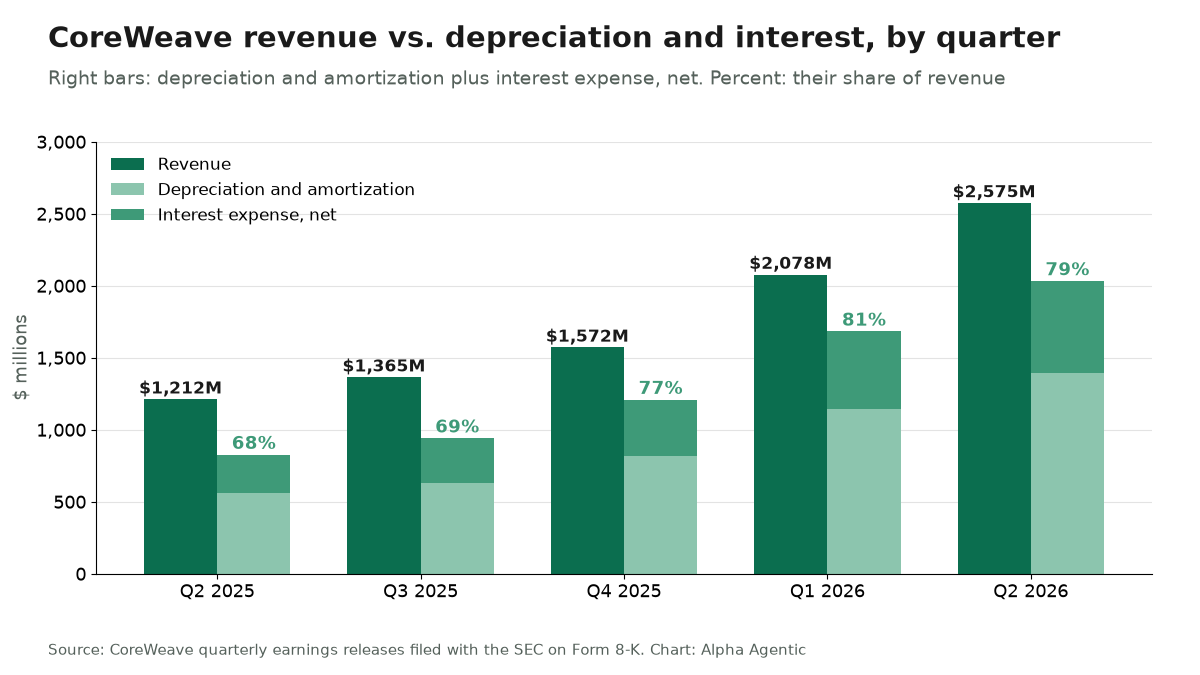
Debt per megawatt held flat: CoreWeave's debt per active MW was $23.8 million a year ago and $23.7 million in Q2 2026. What fell was revenue per active MW, from $10.3 million to $6.9 million, which is why debt rose to 3.5 times annualized revenue from 2.3 times.
Analysis: A falling revenue-per-MW line is not by itself a pricing warning. Capacity is energized before customers are billed, and CoreWeave added nearly 500 MW in Q2 alone, so the income statement carries costs on capacity not yet fully earning. The test on Nov. 10 is whether revenue per active MW stabilizes as the first-half additions start billing.
Backlog per megawatt doubled: Remaining performance obligations per contracted MW rose to $28.0 million from $13.7 million a year earlier. The Q2 release adds that more than $25 billion of net new commitments signed in early Q3 is not yet in its backlog of about $104 billion.
Capex per megawatt: CoreWeave spent $21.5 billion of cash capex over the four quarters to June 30, 2026, while active power rose by 1,030 MW. That is about $20.8 million per MW added, by our math. It understates the full cost, because CoreWeave also buys equipment through $5.1 billion of OEM financing and leases its shells. Its gross property and equipment, including $11.9 billion under construction, was $35.1 million per active MW at June 30.
Our Math: What a Shorter GPU Life Does to Earnings
Nebius said its switch to five-year server lives from four, effective January 2026, reduced second-quarter depreciation by $43.0 million. Without it, the quarter's $175.9 million operating loss would have been about $218.9 million, by our math. Useful life is the single most important estimate in this business.
Each company states one:
- CoreWeave: Six years for technology equipment, per the 10-K. It moved to six from five on Jan. 1, 2023, which cut 2023 expenses by $20 million.
- Nebius: Five years for servers and network equipment from January 2026, up from four, per its Q2 2026 interim financial statements.
- IREN: Five years for HPC hardware and 20 years for buildings, per its FY2026 10-K.
- SpaceX: The filings we reviewed give no useful life for GPU servers. Its prospectus gives a sensitivity for satellites, not compute.
| Sensitivity (Alpha Agentic analysis) | CoreWeave (Q2 2026) | Nebius (Q2 2026) | IREN (Q3 2026) |
|---|---|---|---|
| Gross technology or GPU equipment | $33.8B | Not broken out | $5.8B |
| Straight-line quarterly depreciation at stated life | $1,409M at 6 years | n/a | $291M at 5 years |
| Extra quarterly depreciation, one year shorter | $282M | $43.0M, company figure | $73M |
| Extra quarterly depreciation, two years shorter | $705M | n/a | $194M |
| Reported operating income or loss | $(49)M | $(175.9)M | $(186)M |
Source: CoreWeave Q2 2026 10-Q, IREN fiscal Q1 FY2027 10-Q, Nebius Q2 2026 Form 6-K. Straight-line on gross cost at quarter end; ignores asset age and in-service dates. Reported D&A was $1,393M at CoreWeave and $148M at IREN, whose GPU hardware rose from $2.0B to $5.8B during the quarter. Nebius figure is the company's and covers servers in service at Dec. 31, 2025. Alpha Agentic analysis.
The method: We divide gross equipment cost by the stated life and by four, then repeat with lives one and two years shorter. It is deliberately simple. It ignores asset age, and IREN's GPU base nearly tripled during the quarter, so a full-quarter charge runs ahead of what it booked.
Analysis: The effect is large relative to earnings. A five-year life at CoreWeave would have turned a $49 million Q2 operating loss into about $331 million, and a four-year life into about $754 million. At IREN, a four-year life adds $73 million a quarter against a $186 million operating loss. Useful life decides whether these companies report operating profits at scale.
The case for long lives: Older GPUs are still renting. Nebius reported "more than 30% higher pricing on older-generation GPUs versus Q1." IREN says it signed H100 capacity "at double previous pricing" after the quarter. Both cut against the idea that a chip is worthless once its successor ships.
The case for short lives: Contracts are often shorter than the depreciation schedules. CoreWeave's six-year life matches the top of its one-to-six-year contract range, so many assets must be re-rented at least once. Nebius describes its core contracts as averaging one to three years. Only IREN's five-year Microsoft term lines up with its five-year life.
Debt, Interest and the 2027 Wall
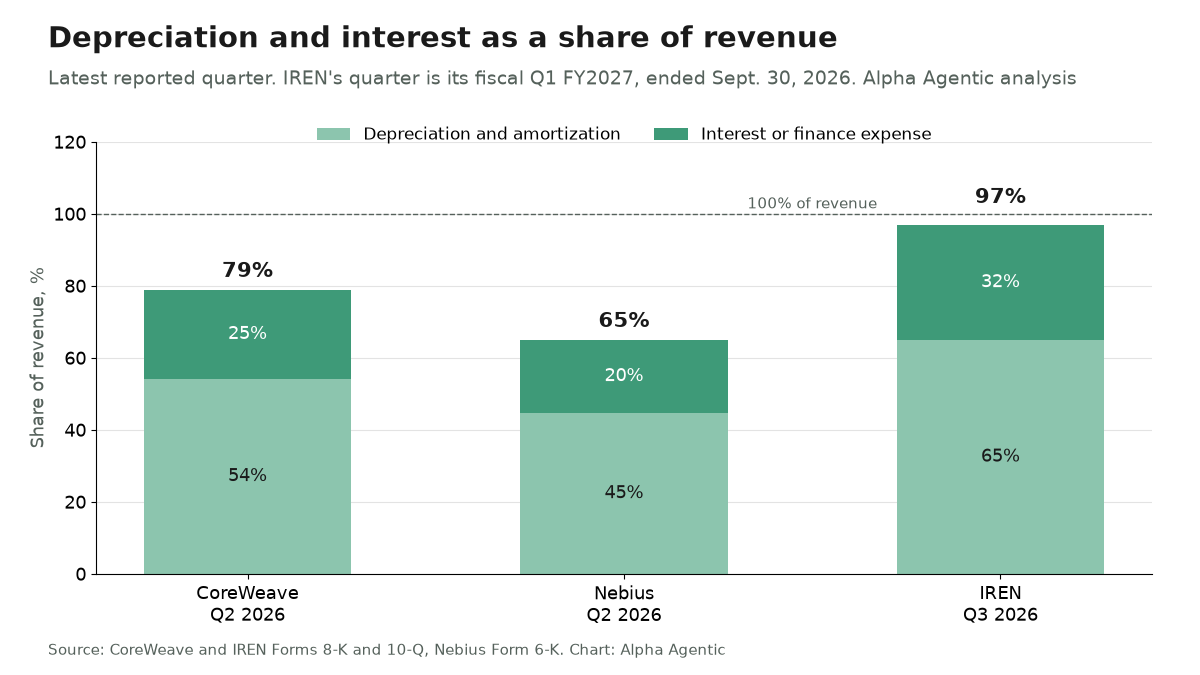
Interest took 24.9% of CoreWeave's Q2 2026 revenue, 20.5% of Nebius's and 32.0% of IREN's Q3 2026 revenue, by our math. A year earlier, Nebius was at 4.6% and IREN at 3.8%. Tranche-by-tranche terms are in the junk bond tracker; what follows is what matters for unit economics.
CoreWeave's maturities: Of $35.6 billion of debt principal, $4.4 billion is due in the rest of 2026 and $6.2 billion in 2027, per the 10-Q. That is $10.6 billion over 18 months, by our math, against $10.0 billion of undrawn facilities at June 30. Its notes mature in 2030 or later, so by our inference the near-term amounts are mostly amortizing term loans and OEM financing; the 10-Q does not break them out. Effective rates on its term loans run from 7% on DDTL 4.0 to 15% on DDTL 1.0. Since June, it has added a $2.6 billion term loan at SOFR plus 5.5% and, per a Sept. 18 release, $3.7 billion of 2.875% convertible notes due 2033.
Analysis: CoreWeave's cost of debt is falling as it shifts to convertibles and investment-grade-backed loans, but the margin on its newest term loan widened from 4.5% on the May facility. Price matters more than access: as debt rolls, each percentage point on $35.6 billion is about $356 million a year, by our math.
Nebius's convertibles: Nebius's $8.5 billion of debt at June 30 was almost entirely convertible notes. They carry low coupons but accrete above face: the March 2026 notes reach 120% of original principal at maturity, so the cash owed exceeds the amount raised. Against $8.0 billion of cash, net debt was about $0.5 billion, by our math. In July it raised its first secured loan, $775 million at SOFR plus 2.5%, backed by GPUs and an investment-grade customer contract. On Oct. 22 it added a $3.5 billion senior secured facility with Citi.
IREN's guarantee: IREN financed its Microsoft GPUs with $3.645 billion of commitments: a $1.545 billion term loan at SOFR plus 2.25% and $2.1 billion of 5.96% notes, per the 10-Q. The 10-K says that if Microsoft validly terminates a funded tranche and no replacement is found, the parent guarantees that tranche's debt, net of GPU sale proceeds. The guarantee is released as Microsoft accepts each tranche. Of $15 billion of remaining planned fiscal 2027 capex, the company counts $9 billion as covered and $6 billion as still to be raised.
Analysis: IREN's $51 million of interest income offsets part of its 32.0% interest ratio. The guarantee is the bigger point: until Microsoft accepts Horizon 2 through 4, IREN's own balance sheet stands behind the project debt.
Who Pays: Concentration and Counterparties
CoreWeave's top three customers supplied 72% of Q2 2026 revenue, against 71% from its single largest customer a year earlier. Diversification is real but slow, and Microsoft has contracts with all three neoclouds.
CoreWeave: Microsoft was 67% of 2025 revenue, per the 10-K. The Q2 10-Q does not name the top three, at 36%, 26% and 10%. Its Q3 2025 release put total OpenAI commitments at up to $22.4 billion. Meta (NASDAQ: META) committed up to $14.2 billion in September 2025, per the 10-K, and up to $21.0 billion more in March 2026, per the 10-Q.
Nebius: Its 20-F describes a Microsoft contract worth up to about $17.4 billion through 2031 and two Meta agreements. The 2025 Meta order is worth about $2.9 billion. The March 2026 agreement is up to $27 billion: $12 billion of dedicated capacity plus up to $15 billion under which Meta buys capacity Nebius fails to sell to others. Three unnamed customers supplied 24%, 21% and 14% of Q2 2026 revenue.
IREN: The Microsoft agreement is worth about $9.7 billion through 2031, with 20% of each tranche prepaid. That is about 48% of IREN's $20.3 billion backlog, by our math, treating the full contract value as still unrecognized. The company says about two-thirds of its backlog is with investment-grade counterparties. Three customers supplied 28%, 24% and 18% of Q3 2026 revenue.
SpaceX: One SI customer supplied 34.5% of SpaceX's consolidated Q3 2026 revenue, per the Q3 10-Q. That is about $5.0 billion, or 66.5% of SI revenue, by our math. Anthropic's S-1 commits it to spend up to $120.5 billion with SpaceX's AI unit, about $3.1 billion a month once capacity is delivered. After non-cancelable periods ending in January and March 2027, either side can cancel on 90 days' notice. Our Anthropic S-1 analysis covers the wider commitments.
Analysis: The Meta backstop at Nebius is the most interesting structure in the group. It turns unsold capacity into a contracted floor that lenders can underwrite. It also suggests hyperscalers see their own capacity as short enough to insure neocloud utilization. Our capex tracker shows the four largest hyperscalers, including Microsoft and Meta, guiding to $720 billion to $740 billion of 2026 capex combined.
Our Math: SpaceX's AI Unit as a Cross-Check
SpaceX's SI segment earned $7.56 billion of revenue in Q3 2026 on 1.7 GW of nameplate compute, or $17.8 million of annualized revenue per megawatt, by our math. That is more than twice CoreWeave's figure, and the gap shows how much definitions matter.
| Cross-check (Alpha Agentic analysis) | SpaceX SI (Q3 2026) | CoreWeave (Q2 2026) |
|---|---|---|
| Revenue in the quarter | $7,560M | $2,575M |
| Megawatt measure | 1.7 GW nameplate, GPU power only | 1.5 GW active power |
| Annualized revenue per MW | $17.8M | $6.9M |
| Cash capex per MW added in the quarter | $54.8M | About $12.8M |
| Depreciation and amortization vs revenue | 32.7% | 54.1% |
| Largest customer's share | 66.5% of SI revenue | 36% of revenue |
Source: SpaceX Q3 2026 10-Q segment note and key metrics; CoreWeave Q2 2026 release and 10-Q. Capex per MW: SpaceX $16.4B over 0.3 GW added; CoreWeave $6.4B over about 500 MW added. Alpha Agentic analysis.
Analysis: Three things explain the gap. SpaceX's megawatts exclude cooling and overhead, which shrinks the denominator. SpaceX installs the newest systems and rents them to labs at scarcity prices. And its $54.8 million of capex per megawatt added is in line with the $50 billion to $60 billion per gigawatt that the CEO of Nvidia (NASDAQ: NVDA) has cited, as our power deep dive explains. CoreWeave's quarterly capex looks low because it excludes vendor-financed gear and rented shells.
SpaceX had $51.3 billion of cash at Sept. 30 against $38.0 billion of debt, including $13.0 billion of "other financings" that cover SI infrastructure booked as failed sale-leasebacks. Our SpaceX Q3 analysis covers the segment's results.
The Bull Case and the Bear Case
Bull case:
- Contracted, not speculative: CoreWeave, Nebius and IREN reported $103.7 billion, $37.5 billion and $20.3 billion of backlog or obligations, $161.5 billion in total, by our math. Much of it is take-or-pay.
- Investment-grade counterparties: Microsoft has multibillion-dollar contracts with all three, and Meta with CoreWeave and Nebius. Lenders accept CoreWeave's contracts as collateral at margins as low as SOFR plus 2.25%.
- Customers fund the build: Nebius expects more than $9 billion of prepayments in 2026. In a five-year deal IREN signed after the quarter, the customer prepays 90% of the GPU capex.
- Pricing is rising: Nebius sees a $40 million to $50 million per MW opportunity on short-term capacity. IREN says 3-year and 5-year contract pricing rose 11% and 12%.
- Paybacks are short: Nebius puts the payback on Q2 deals at 1 year and 10 months, down from two to three years.
Bear case:
- Depreciation flatters earnings: By our math, one year off CoreWeave's GPU life would add $282 million to quarterly costs. Nebius has just lengthened its own.
- Contracts end before the asset life: CoreWeave's contracts run one to six years against a six-year life. Its newest term loan runs about five years against contracts averaging about three, per the junk bond tracker.
- Refinancing: CoreWeave has $10.6 billion of principal due by the end of 2027. Interest already takes 20% to 32% of revenue across the group.
- Concentration: Top three customers supply 59% to 72% of revenue. One customer is about 48% of IREN's backlog.
- Delivery risk: IREN's run-rate target slipped to January 2027 and may extend to February. Microsoft's revenue starts only on acceptance.
The Alpha Take
By our math, CoreWeave and Nebius carried about 3.5 and 3.7 times their annualized Q2 2026 revenue in debt. The risk is in how long that revenue lasts. This is Alpha Agentic analysis, not investment advice.
What the filings show: The contracts are real and the counterparties mostly strong. At CoreWeave, obligations per contracted megawatt doubled in a year while debt per active megawatt stayed flat.
What the filings also show: Depreciation, amortization and interest now take 65% to 97% of revenue across the three. CoreWeave's revenue per active megawatt fell to $6.9 million from $10.3 million as capacity outran billing. And a company can widen or narrow its reported profit by a year of useful life, which Nebius has just done.
Where we land: In our view, the neocloud trade is a bet on residual value. If GPUs rent for six years, today's backlog funds the debt and leaves equity value. If they rent for four, the second lease has to cover the gap. Older-chip pricing is rising for now, which helps. The cleanest structures put risk elsewhere: Meta's backstop at Nebius, IREN's 90% prepayment and CoreWeave's contract-backed term loans. The weakest put a parent guarantee behind project debt while the customer can still terminate.
What would change our view: Two consecutive quarters of rising revenue per active megawatt at CoreWeave would show the capacity overhang is clearing. A cut in any company's useful life, or a second-lease contract priced well below the first, would show the bear case arriving.
What to Watch
CoreWeave and Nebius report Q3 2026 this week, the first test of the per-megawatt figures above.
- Tuesday, Nov. 10, call at 5 p.m. ET: CoreWeave discusses Q3 2026, per its investor relations page. Watch revenue per active MW against $6.9 million, backlog once the more than $25 billion of early-Q3 commitments is included, interest against 24.9% of revenue and any change to the six-year life.
- Thursday, Nov. 12, before the open, call at 8 a.m. ET: Nebius reports Q3 2026, per its newsroom. Watch interest against 20.5% of revenue, prepayments against the $9 billion target, any draw on the Citi facility and whether it discloses active megawatts.
- December 2026: The commitment period on CoreWeave's $2.6 billion DDTL 5.5 loan ends, per the 10-Q. Watch how much was drawn.
- January to February 2027: IREN's revised window for its more than $4 billion run-rate target. Watch Microsoft's acceptance of Horizon 2 through 4.
- Early 2027: Nebius's second Meta agreement is due to come online, and Anthropic's SpaceX contracts pass their non-cancelable periods.