SpaceX Q3 2026: Renting GPUs to AI Rivals Starts Paying for the Buildout
SpaceX's Super Intelligence segment earned $5 billion of adjusted EBITDA as cloud deals ramped. Capex still outran cash flow, and orbital compute went unmentioned.
Update: This article was updated on Nov. 9, 2026. It originally described the SpaceX–Anthropic cloud deals as cancelable by either side after an initial three months on 90 days' notice, as SpaceX's IPO prospectus stated. Anthropic's S-1, filed Oct. 26, says the deals were later amended and carry non-cancelable periods ending in January and March 2027, after which either side can cancel on 90 days' written notice.
SpaceX (NASDAQ: SPCX) just showed that renting out scarce GPUs can start to pay for an AI buildout. In third-quarter results released after the close on Oct. 20, its AI business, now renamed Super Intelligence (SI), swung from an operating loss to the company's largest source of adjusted EBITDA. The release credits cloud services deals first, ahead of Cursor and Grok.
That matters beyond SpaceX. It is hard evidence that frontier compute is still scarce enough to earn rich margins. But the contracts behind it can be canceled on short notice. And the orbital data centers that anchor SpaceX's long-term pitch got no mention in the earnings release.
What SpaceX reported
These figures come from the release, also furnished in an 8-K filing.
| SPCX, $ millions | Q3 2026 | Q2 2026 | Q3 2025 |
|---|---|---|---|
| Total revenue | 14,575 | 7,814 | 5,576 |
| SI revenue | 7,560 | 2,561 | 813 |
| Connectivity revenue | 5,248 | 4,291 | 3,097 |
| Space revenue | 1,767 | 962 | 1,666 |
| Income (loss) from operations | 2,791 | (143) | (273) |
| Total capex | 19,593 | 18,369 | 6,880 |
Net income was $4.4 billion. Adjusted EBITDA was $8.8 billion.
SI revenue, and what the compute costs
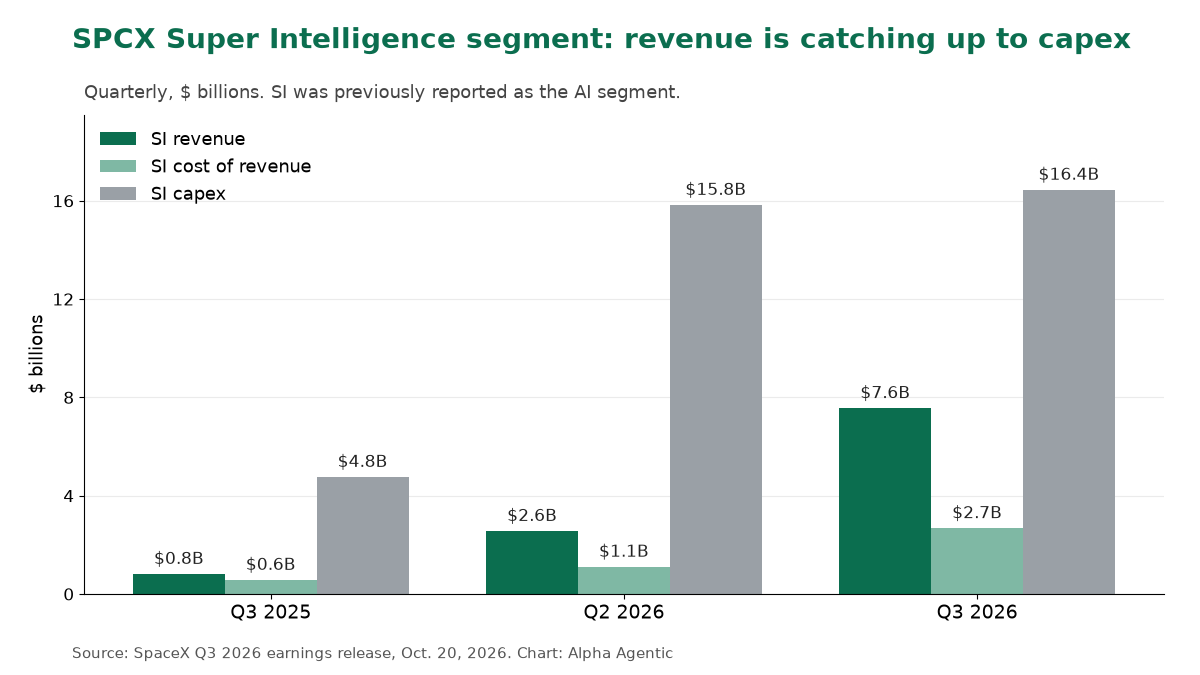
SI revenue nearly tripled from the second quarter to $7.6 billion. Of that, $7.0 billion came from SI solutions and infrastructure, up from $2.2 billion. Cursor contributed $608 million after its Aug. 14 close.
Costs grew more slowly. SI cost of revenue, which covers data center leases, energy and server depreciation according to the second-quarter 10-Q, was $2.7 billion. SI research and development was $3.2 billion. The segment posted $431 million of operating income after $1.2 billion of stock compensation tied to Cursor. SI adjusted EBITDA was $5.0 billion.
Analysis: Cost of revenue fell to about 35% of SI revenue from 43% in Q2. Adjusted EBITDA margin rose to roughly 66% from 45%. That is what renting GPUs at scarcity prices looks like.
Capex and capacity
Total capex was $19.6 billion, and $16.4 billion of it went to SI. That is close to the Q2 pace, in line with CFO Bret Johnsen's guidance on the Q2 call that the next two quarters would look "very similar" to Q2.
Nameplate compute reached 1.7 GW at Sept. 30. That is up 0.3 GW in the quarter, versus 0.4 GW added in Q2. On the Q2 call, SpaceX said it expected to end 2026 "at over 2 GW."
Analysis: Cash from operations was about $9.6 billion in Q3, based on nine-month figures in the Q3 release less first-half figures in the Q2 release. Capex exceeded it by roughly $10 billion. Cash and marketable securities fell to $89.9 billion from about $100 billion at June 30.
Backlog: no update yet
SpaceX reported $47.5 billion of backlog at June 30. The Q3 release gives no backlog figure. That should come with the 10-Q, which had not been filed as of this writing.
One partial signal: deferred revenue rose to $17.5 billion from $14.3 billion. It is only a slice of backlog, not a substitute.
The Anthropic relationship
The release names no customers. The disclosed terms come from SpaceX's IPO prospectus. Anthropic, which is still private, agreed to pay $1.25 billion a month through May 2029 for capacity across Colossus and Colossus II, about 325,000 Nvidia (NASDAQ: NVDA) GPUs. Anthropic's S-1, filed Oct. 26, says the deals were amended through October to up to $120.5 billion into 2029, about $3.1 billion a month once all capacity is delivered. After non-cancelable periods ending in January and March 2027, either side can cancel each agreement on 90 days' written notice. Anthropic has said it is also interested in developing "multiple gigawatts of orbital AI compute capacity" with SpaceX. Anthropic's own draft IPO filing lists about $450 billion of cloud compute commitments, according to The Wall Street Journal.
A second deal with Alphabet's (NASDAQ: GOOGL) Google pays $920 million a month from October 2026 through June 2029, after a reduced-fee ramp through September.
Analysis: At the full disclosed rate, Anthropic alone would be $3.75 billion a quarter, about half of Q3 SI solutions and infrastructure revenue. SpaceX has not confirmed what Anthropic paid in Q3. In Q2, a single SI customer was 19.5% of total revenue.
Starlink connectivity
Connectivity revenue rose 69% from a year earlier to $5.2 billion. Operating income nearly doubled to $2.4 billion. Starlink ended the quarter with 13.6 million consumer subscribers, up 1.6 million, and average monthly revenue per consumer subscriber rose to $69 from $66. Enterprise and government revenue was $2.1 billion. SpaceX also agreed to buy 800 MHz spectrum for Starlink Mobile.
Starlink is also the network SpaceX's prospectus says will link its planned orbital AI satellites.
Orbital compute: silence, with one real milestone
The release says nothing about orbital data centers. The prospectus still targets deploying orbital AI compute satellites "as early as 2028." On the Q2 call, Elon Musk said SpaceX expected to start launching its Starmind AI satellites next year.
The real milestone was Starship Flight 14. SpaceX calls it the first revenue-generating Starship mission. It put 26 Starlink V3 satellites into orbit. Our orbital compute deep dive argues the economics need launch prices about 10 to 20 times below today's. The release gives no Starship price per kilogram.
The skeptical view
Rental, not moat: SI's margin comes largely from leasing GPUs to labs that compete with Grok. Both disclosed deals allow exit on 90 days' notice, and Google told TechCrunch its deal was "bridge capacity."
Earnings quality: Pre-tax income of $4.0 billion included $1.0 billion of other income and $0.9 billion of interest income. A $390 million tax benefit pushed net income higher.
Dilution and depreciation: Cursor brings $23.4 billion of stock awards for future service. GPUs also depreciate fast, and SI depreciation rose 31% in a quarter.
The Alpha Take
This quarter turned SpaceX into a profitable GPU landlord. It shows frontier labs will pay rich prices for capacity they can switch on now.
It also shifts the risk. SpaceX's AI economics now depend on how long compute stays scarce and how long rivals keep renting rather than building. Capacity additions slowed in Q3. Orbital compute remains a promise, and Starship's first commercial flight is a step toward the launch costs it needs, not proof of them. This is analysis, not investment advice.
What to Watch
- The 10-Q: Backlog versus $47.5 billion, customer concentration and remaining contract terms.
- Google's full-rate start: October is the first month at the $920 million monthly fee.
- Capacity: Whether nameplate compute clears 2 GW by year-end.
- Cash burn: Capex versus operating cash flow, and the cash balance.
- Contract durability: Any notice of termination, renewal or new cloud customers.
- Orbital compute: A first Starmind launch date, a Starship price per kilogram, or a paying orbital customer.