AI's Power Problem, Measured: What Big Tech Capex Buys in Gigawatts, and Who Gets Paid
We convert $720B to $740B of 2026 Big Tech capex into gigawatts, test it against PJM and ERCOT queues and map who gets paid.
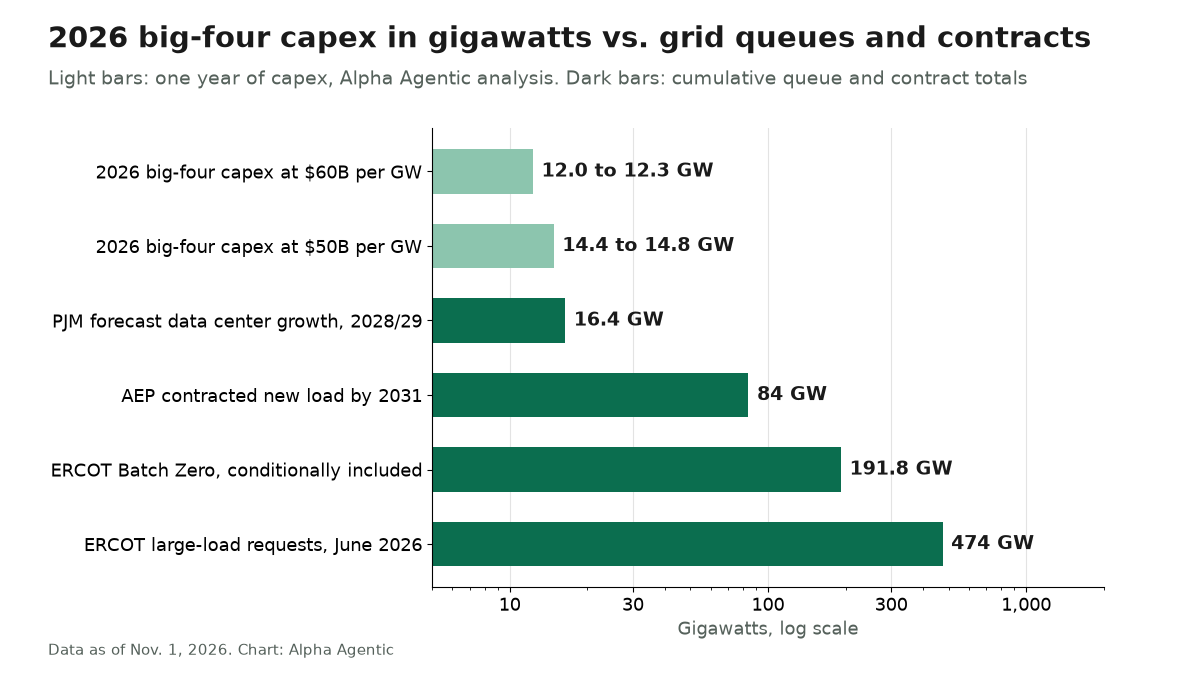
AI's power problem is real, but it is smaller and more specific than the grid queues suggest. The four largest US cloud spenders guide to about $720 billion to $740 billion of 2026 capex, which buys about 12 to 15 gigawatts of data center capacity a year, by our math. Texas alone had 474 GW of large loads asking to connect as of June. Speculative requests inflate the queues, but contracted and forecast demand is still large enough to leave PJM short of capacity, and gas turbine makers are now selling slots for 2032. In our analysis, the winners are whoever controls the scarce parts: grid connections, firm generation, turbines and switchgear.
Key numbers
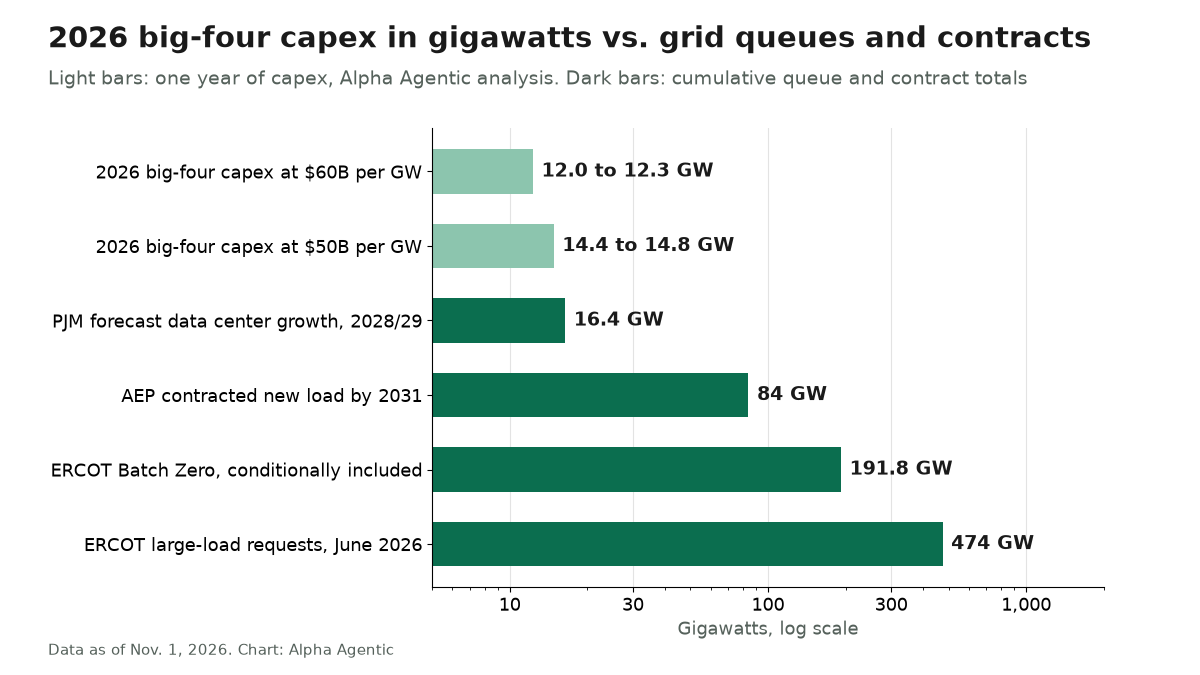
Capex in gigawatts: About $720B to $740B of 2026 big-four capex guidance equals about 12 to 15 GW at $50B to $60B per GW, by Alpha Agentic analysis.
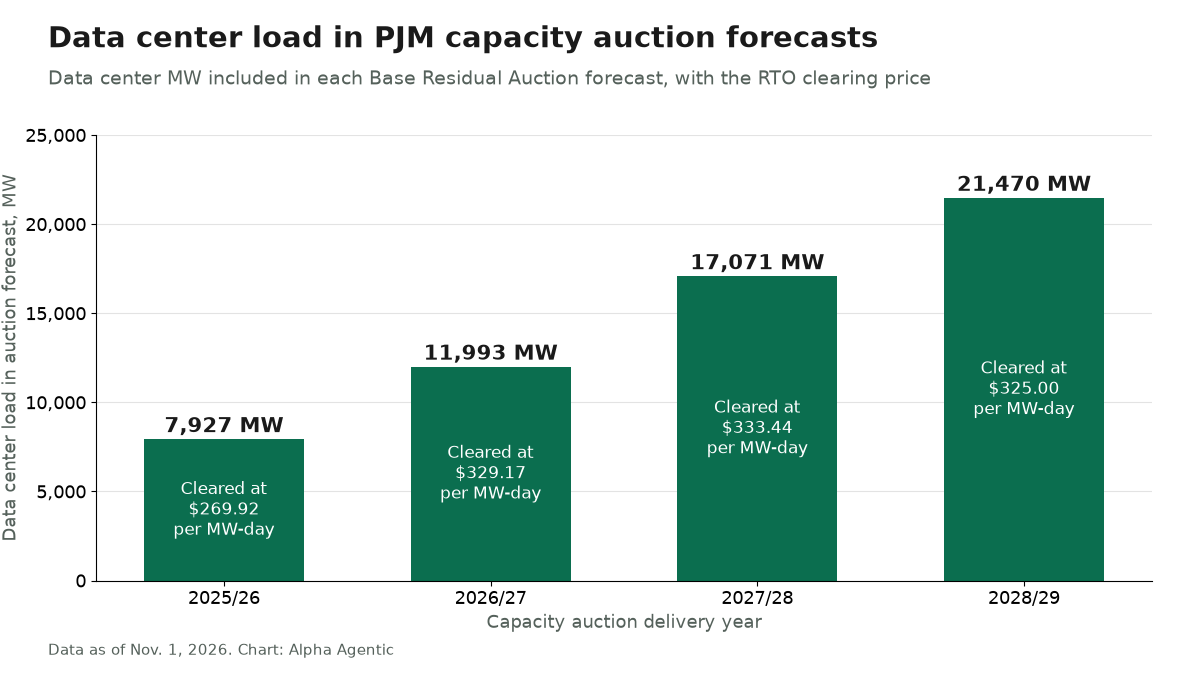
PJM data center load: 21,470 MW in the 2028/29 capacity auction forecast, up from 7,927 MW in the 2025/26 auction.
Capacity bill: Data center load added $6.27B to PJM's $16.4B of 2028/29 capacity revenues, per the market monitor on Oct. 30, 2026. That is 38% of the total, by our math.
Texas queue: 474 GW of large loads sought ERCOT connection in June 2026, up from about 410 GW in March 2026.
Turbines: GE Vernova (NYSE: GEV) expects at least 130 GW of gas under contract by the end of 2026, up from 83 GW at the start of the year.
Wholesale prices: EIA forecasts PJM West power at $84.95/MWh in 2026, up from $60.09 in 2025, while ERCOT North falls to $33.68 from $37.33.
How Big Is the Load? What EIA, LBNL and PJM Measure
The U.S. Energy Information Administration's October 2026 outlook expects commercial electricity sales, the category that holds most data centers, to rise 3.8% in 2026 to 1,549 billion kWh, an increase of 56 terawatt-hours. The EIA's Short-Term Energy Outlook, Table 7a shows commercial sales up about 5.3% in Q3 2026, to 438 billion kWh from 416 billion in Q3 2025. Part of Q3 2026 is still estimated.
Lawrence Berkeley National Laboratory's 2025 update of the US data center energy report, published in June 2026, puts 2030 data center use at 649 TWh in its reference case. The range runs from 521 TWh to 843 TWh, or 9.5% to 15.3% of US electricity. The prior edition projected 6.7% to 12.0% by 2028.
The sharpest measurement is in PJM, the grid operator for 13 states and Washington, D.C. Its capacity auctions buy plant commitments three years ahead, using a load forecast. According to a July 27 presentation by PJM's Independent Market Monitor, data center load in those forecasts rose from 7,927 MW in the 2025/26 auction to 21,470 MW in the 2028/29 auction. Of the latest figure, 16,436 MW is forecast load above the data center load already embedded in PJM's base forecast. The remaining 5,034 MW is that embedded load, by our math.
Our Math: Turning Capex Guidance Into Gigawatts
Microsoft (NASDAQ: MSFT), Alphabet (NASDAQ: GOOGL), Meta (NASDAQ: META) and Amazon (NASDAQ: AMZN) together guide to about $720 billion to $740 billion of 2026 capital spending. That equals about 12 to 15 GW of data centers at the $50 billion to $60 billion per gigawatt that the CEO of Nvidia (NASDAQ: NVDA) has cited. This section is Alpha Agentic analysis, with every input shown.
The spending: Microsoft guides to "approximately $170 billion" for calendar 2026, down from about $175 billion, per its earnings call. Alphabet kept its $195 billion to $205 billion range on its Oct. 28 call. Meta narrowed its range to $135 billion to $145 billion. Amazon still expects "approximately $220 billion," per its Q3 2026 release. The Hyperscaler Capex Tracker follows these figures quarter by quarter, and our Microsoft and Alphabet Q3 2026 results pieces cover the latest calls.
The price per gigawatt: On Nvidia's Aug. 26 earnings call, Jensen Huang said "each gigawatt of data center increased from, say, $30 billion about five years ago to now $60 billion today." At GTC Berlin on Oct. 21, he put it at $50 billion, including land, power, shell, compute, networking and cooling, according to Yahoo Finance.
| Scenario (Alpha Agentic analysis) | Cost per GW | Full-year guide (2026) | Annualized run rate (Q3 2026) |
|---|---|---|---|
| Capex dollars | n/a | $720B to $740B | $830B |
| High cost per GW | $60B | 12.0 to 12.3 GW | 13.8 GW |
| Lower cost per GW | $50B | 14.4 to 14.8 GW | 16.6 GW |
Source: Company guidance and Q3 2026 capex of $45.2B (MSFT, incl. finance leases), $51.4B (GOOGL), $34.9B (META) and $75.9B (AMZN); cost per GW from Nvidia's CEO. Alpha Agentic analysis.
The cross-check: Huang's figure can be rebuilt from two disclosed pieces. Nvidia puts its own revenue opportunity, the chip and system layer, at about $40 billion per gigawatt with Vera Rubin, up from $18 billion with Hopper. For the building and power layer, Meta's October 2025 release on its Hyperion campus in Louisiana set about $27 billion of costs for "buildings and long-lived power, cooling, and connectivity infrastructure." Meta's site page describes the campus as delivering over 2 GW of compute capacity, and in July 2026 Meta committed more than $50 billion to reach 5 GW of IT capacity, per Louisiana Economic Development. If the $27 billion covered the first 2 GW, that implies about $10 million to $13.5 million per MW for the shell and power layer. Add Nvidia's $40 billion per GW, and the total is about $50 billion to $53.5 billion per GW, within the $50 billion to $60 billion range of Huang's two figures.
What the shortcut misses: Four caveats cut in different directions. Not all of this spending is in the US or on AI; Amazon's includes retail logistics. Finance leases are counted differently. Spending runs ahead of energization, so 2026 dollars become 2027 and 2028 load. And Huang's "gigawatt" may mean IT load rather than total facility draw, which is higher once cooling is included; Hyperion's 5 GW, for one, is stated as IT capacity. If only 80% of the capex goes to AI data centers, the range falls to about 9.6 to 11.8 GW.
From gigawatts to energy: At an assumed 80% average use, 12 to 15 GW draws about 84 to 104 TWh a year. That is more than EIA's entire 56 TWh rise in US commercial sales for 2026. The gap is consistent with much of this capacity being abroad or not yet energized.
The Queues: Why the Requests Do Not Add Up
ERCOT, the Texas grid operator, told state senators on July 29, 2026, that about 474 GW of large loads were seeking interconnection as of June, about 90% of them data centers. That is about 427 GW of data center requests, or 29 to 36 years of big-four capex at the current pace, by our math, per the ERCOT Senate presentation. ERCOT's April update counted about 410 GW on March 26, up 178 GW since the end of 2025.
ERCOT's Batch Zero update for its September board meeting conditionally included 362 projects: 66.4 GW of base load and 125.4 GW of studied load. The deck's summary text gives 127.9 GW for studied load; using the chart figure, the total is 191.8 GW. Another 373 projects, with 302.2 GW, were excluded. That is 61% of the capacity sorted, by our math. ERCOT has paused energization of new data centers of 75 MW or more until its eligibility audit and community-impact review are complete.
Why queues inflate: Queue spots are cheap. ERCOT's process requires $50,000 per MW of security. That is $50 million per gigawatt, or about 0.1% of a $50 billion build, by our math. The 10-Q of American Electric Power (NASDAQ: AEP) says its AEP Texas unit received about $2 billion of security for 45 GW seeking Batch Zero, or about $44,000 per MW, by our math. Developers can hold several sites as cheap options.
The generation side has the same problem: LBNL's Queued Up 2026 edition counted 2,061 GW of generation and storage waiting to connect at the end of 2025, down 10% in a year. More than 750 GW withdrew. Gas requests rose 86% to 253 GW. Only 13% of capacity requested from 2000 to 2020 reached operation. The median project built in 2025 took 61 months from request to operation. The report counts plants, not loads.
Utility contracts are firmer, but still large: AEP said in its Oct. 28 results that it signed 15 GW of new load commitments in Q3 2026. It now counts 84 GW of incremental contracted load by 2031, backed by electric service agreements or letters of agreement. Dominion Energy (NYSE: D) reported about 54.9 GW of data center capacity in various stages of contracting in its Q3 2026 earnings presentation, up about 6.3 GW since December 2025, including more than 12 GW under electric service agreements. Southern Company (NYSE: SO) had 17 GW of contracted large load after Q2 2026, executives said on its earnings call, Utility Dive reported. Those three utilities alone list about 156 GW, by our math, at different stages of contracting.
Capacity Prices: PJM Is Short Even After Forecast Cuts
PJM's 2028/29 capacity auction, released July 14, 2026, cleared 138,318 MW at the $325 per MW-day price cap and still fell 6,831 MW short of its reliability requirement. The cleared capacity was valued at $16.4 billion, the same as the year before. The PJM release and results report show just 525 MW of new generation and uprates cleared.
PJM's RTO clearing price jumped from $28.92 per MW-day for 2024/25 to $269.92 for 2025/26, then $329.17, $333.44 and $325.00, the last three at or near their caps.
The market monitor's Oct. 30 analysis says data center load added $6.27 billion, or 61.8%, to 2028/29 capacity revenues compared with an auction without it. That is 38% of the total, by our math. Across four auctions the monitor puts the data center effect at $29.4 billion. Its conclusion: "There would have been no shortfall but for the forecast data center load."
The forecast is moving too: The same report shows PJM's 2026 load forecast cut the 2028 summer peak to 165,567 MW from 169,981 MW a year earlier, a cut of 4,414 MW, by our math. The actual 2026 peak was 158,005 MW on July 2, about 1% above the forecast. The next auction, for 2029/30, runs Dec. 9 to 15.
What a gigawatt pays in PJM (Alpha Agentic analysis): At $325 per MW-day, capacity is worth about $119 million per GW per year. Energy at EIA's 2026 PJM West forecast of $84.95/MWh, at 80% use, adds about $595 million. That is about $714 million a year, or 1.2% to 1.4% of the $50 billion to $60 billion it costs to build the data center. Power is a small line in the budget and the hardest to get, which may help explain why buyers accept long contracts and higher turbine prices.
Who Gets Paid: Utilities, Power Producers, Turbines and Gear
The spending reaches power suppliers through four channels, each with disclosed contract evidence from the past 12 months: rate base, long-term power contracts, turbine orders and electrical equipment backlogs. Our forthcoming AI Datacenter Power Deals Tracker will list deals in full; this section explains the mechanics.
| Layer | Companies | Disclosed evidence | How it pays |
|---|---|---|---|
| Regulated utilities | AEP, Dominion, Southern | AEP: 84 GW contracted by 2031; $100B five-year capital plan | Return on rate base |
| Power producers | Vistra (NYSE: VST), Constellation Energy (NASDAQ: CEG), Talen Energy (NASDAQ: TLN) | 20-year nuclear PPAs with Amazon, Meta, Google and Microsoft | Contract price plus capacity revenue |
| Turbines | GE Vernova | 122 GW of gas backlog and slot reservations; 2032 slots sold | Orders, deposits, service |
| Electrical gear and grid work | Eaton (NYSE: ETN), Vertiv (NYSE: VRT), Quanta Services (NYSE: PWR) | Quanta backlog $63.7B, up 63% in a year | Backlog and pricing |
Source: AEP Q3 2026 release, company PPA releases and 8-Ks, GE Vernova Q3 2026 call, Quanta Q3 2026 release. Growth rates are Alpha Agentic calculations.
Utilities: AEP plans $100 billion over five years, including $37 billion for transmission and $36 billion for generation. It also expects up to $21 billion of fixed-cost offsets for residential customers from large-load contracts, up from $16 billion. Its 10-Q describes a proposed 10.4 GW campus at Piketon, Ohio, served by three 765 kV lines of about 3.2 GW each, targeted for service from 2028 to 2030.
Power producers: Vistra signed a 20-year, 1,200 MW contract at its Comanche Peak nuclear plant, disclosed in a September 2025 8-K. Deliveries start in late 2027. The buyer was later named as Amazon, per World Nuclear News. In January 2026, Vistra and Meta announced 20-year deals for 2,609 MW, including 433 MW of uprates. Constellation signed Google on Oct. 6 to a 20-year contract for 890 MW of new uprate capacity, backed by more than $4.3 billion of investment. That is about $4.8 million per MW of new capacity, by our math. On Sept. 30 it signed Amazon to 690 MW at Calvert Cliffs. It also has deals for 835 MW with Microsoft and 1,121 MW with Meta. Talen contracted 1,920 MW to Amazon through 2042.
Capacity revenue is now financeable: Talen's Sept. 29 8-K shows it transferred the rights to future cash flows from about 6.5 GW of cleared PJM capacity for 2027/28 and 6.0 GW for 2028/29, with aggregate revenues of about $1.5 billion. The pricing was SOFR plus 2 percentage points. Its Nov. 3 results confirm the transaction closed Oct. 1: rights to about $1.5 billion of future capacity cash flows produced $1.3 billion of net proceeds, used to fund its accelerated share repurchase. Those capacity volumes at the RTO clearing prices come to about $1.50 billion before discounting, by our math. The distinction matters: selling future receipts accelerates cash; it does not create another $1.5 billion of operating earnings.
Turbines: GE Vernova said on its Oct. 28 call that it has signed 52 GW of new gas agreements so far in 2026. It expects at least 130 GW under contract by year-end, up from 83 GW at the start. It has sold slots for 2032 delivery. Its CEO expects 2026 gas pricing per kW to run about 50% above 2025. Its 10-Q shows remaining performance obligations of $196.7 billion, up from $135.3 billion a year earlier. Our Q3 infrastructure scorecard covers the quarter in detail.
Electrical gear and contractors: Eaton reported Q3 2026 results on Nov. 3: Electrical Americas sales reached $4.2 billion, up 22% organically, with a 29.8% operating margin. Its rolling 12-month organic orders rose 39%, and segment backlog rose 33% year over year. That 33% is not the whole Electrical sector: combined Electrical backlog rose 46%. The company presentation says rolling 12-month Electrical data center orders more than doubled and Q3 data center revenue rose about 65% year over year. Companywide sales were $8.947 billion, adjusted EPS was $3.68 and GAAP EPS was $2.77. Eaton raised its full-year organic-growth guide to 13% to 15% and its adjusted EPS guide to $13.70 to $13.80. In our view, orders growing faster than revenue show the queue for equipment has not cleared, even as new capacity turns into output. Vertiv posted Q3 2026 sales of $4.31 billion, above its $3.65 billion to $3.85 billion guide. Quanta reported backlog of $63.73 billion, up from $39.17 billion a year earlier.
Policy: Co-Location, Large-Load Rules and the Texas Pause
The Federal Energy Regulatory Commission set PJM's rules for data centers built next to power plants in a June 18, 2026 order, and on Oct. 9 it accepted parts of PJM's broader large-load plan while rejecting others. Both change who pays for grid service.
Co-location: FERC's June order followed its December 2025 finding that PJM's tariff was unjust and unreasonable on co-located load. It requires such load to take a defined transmission service: network service, firm contract demand or non-firm contract demand. Vistra's CEO said in August he was "very pleased with FERC's colocation order," Utility Dive reported. In our analysis, deals now carry clearer transmission costs.
PJM's large-load plan: In its Oct. 9 order, FERC accepted PJM's definition of a large load, with a 50 MW threshold, and a large-load registry. It rejected PJM's Interim Resource Adequacy Service, under which new large loads without new capacity could be curtailed in emergencies, and the related "bring your own new capacity" rules. FERC found them either outside its authority or not shown to be just and reasonable. Jefferies called the outcome positive for independent power producers such as Vistra, Constellation and NRG (NYSE: NRG), Utility Dive reported. Supporters of the rejected tools said they would speed connections.
States: Texas went furthest. Governor Greg Abbott sent a directive letter to regulators and ERCOT on Aug. 3, and ERCOT paused energization of new large data centers the same day. Its audit and community-impact reports are due Dec. 10. Elsewhere, utilities are writing large-load tariffs with minimum bills, long contracts and collateral, as Southern's CEO described, per Utility Dive. AEP's fixed-cost offsets point the same way: in our view, they shift stranded-cost risk from households to data center customers.
The Bear Case and the Bull Case
The strongest bear argument is that grid queues overstate real demand many times over, and the strongest bull argument is that PJM is already 6,831 MW short with only a fraction of forecast data centers built.
Bear case:
- Speculative queues: Texas requests equal decades of big-four capex, by our math. ERCOT excluded 302.2 GW in its first sort. Only 13% of generation capacity requested from 2000 to 2020 reached operation.
- Forecasts are being trimmed: PJM cut its 2028 peak forecast by 4,414 MW. Vistra lowered its ERCOT load growth outlook to 4% to 6% from 5% to 6%, per Utility Dive. Its CEO said: "I'd like to see the queues culled."
- Efficiency: Nvidia said Vera Rubin delivers "30x higher throughput per megawatt" than Grace Blackwell Ultra. More work per watt can mean fewer watts for the same output.
- Capex discipline: Microsoft trimmed its 2026 guide by about $5 billion.
- Policy risk: The Texas pause shows a state can stop energization.
Bull case:
- The shortfall is physical: PJM cleared only 525 MW of new generation and uprates in its latest auction. The market monitor says there would have been no shortfall but for forecast data center load.
- Contracts are binding: AEP's 84 GW rests on electric service agreements or letters of agreement. Most of the nuclear PPAs above run 20 years. GE Vernova's down payments and slot reservations helped lift contract liabilities, which added $19.5 billion of operating cash in the first nine months of 2026.
- Supply is slow: The median generation project built in 2025 took more than five years to connect. Turbine slots run to 2032.
- Spending keeps rising: Amazon's CEO said the company will "spend meaningfully more in 2027," per its call transcript. The Q3 2026 run rate already implies 13.8 to 16.6 GW a year, by our math.
What the Power Producers Have Shown, and What Comes Next
Talen and Eaton reported on Nov. 3, and Vistra followed on Nov. 6. Constellation's company events page now confirms its Q3 2026 earnings call for Monday, Nov. 9, at 9 a.m. ET. That report is still upcoming as of Nov. 8.
Talen: Its Q3 release shows $669 million of adjusted EBITDA, up from $363 million in Q3 2025, and $433 million of adjusted free cash flow, up from $223 million. GAAP net income attributable to stockholders fell to $138 million from $207 million. The company attributes the adjusted growth to acquired generation, higher settled power prices and generation volumes, and higher capacity revenue; it is not a clean measure of AI demand. Capacity revenue rose to $323 million from $166 million. Talen set 2026 adjusted EBITDA guidance at $2.05 billion to $2.20 billion and introduced $2.50 billion to $2.85 billion for 2027, about 26% higher at the midpoint. The next test is how much of that growth comes from acquired assets versus repricing the existing fleet and deliveries under the Amazon contract.
Vistra: Its Nov. 6 presentation reports $2.378 billion of Q3 2026 ongoing operations adjusted EBITDA and $1.140 billion of consolidated GAAP net income. It narrowed 2026 ongoing operations adjusted EBITDA guidance to $7.1 billion to $7.5 billion and introduced a $7.7 billion to $8.5 billion range for 2027, reflecting the Cogentrix acquisition and the first phase of its Meta operating PPA. These are no longer the Q2 opportunity ranges that excluded Meta. The presentation still expects annual energy growth of about 4% to 6% in ERCOT and 2% to 3% in PJM. Watch execution of the existing PPAs and new contracts rather than treating all of the higher earnings guide as new AI demand.
Constellation: The upcoming report will be its first since the Google and Amazon contracts. It will test how fast the more than $4.3 billion of Google-linked uprate investment and the more than $3 billion at Calvert Cliffs turn into earnings. It will also test the demand-flexibility terms in the Google deal and how its 55 GW fleet is exposed to PJM capacity prices near the cap.
What these producers test together: Whether contract prices hold as more supply bids for the same buyers. If utilities win more of the load, the premium for merchant nuclear could narrow.
The Alpha Take
By our math, the four largest buyers are funding about 12 to 15 GW of data center capacity a year, set against a grid where the median new generation project took more than five years to connect. That is Alpha Agentic analysis.
What changed this fall is the quality of the evidence. A year ago the debate ran on forecasts. Now it has 20-year contracts, a monitor's dollar count of data center costs, turbine slots sold for 2032 and a Texas queue sorted into in and out. Queue figures are the weakest evidence; contracts and auction results the strongest. The gap between capex-implied gigawatts and queued gigawatts is wide enough that headline queue growth tells investors little on its own.
The payment flow is also clearer. Utilities collect through rate base and are writing tariffs to push risk onto data centers. Power producers collect through long contracts and capacity prices, and Talen has shown capacity revenue can be sold forward. Equipment makers collect first, through deposits and backlog, and would likely be the first to feel a slowdown in orders.
For related coverage, see our Q3 earnings preview, the datacenter junk bond tracker on how builders finance sites, Meta's Q3 results and Meta's $35 billion stock offering, and our guide to space data centers, the most extreme answer to the grid bottleneck.
What to Watch
The Nov. 3 equipment and power results are now in. These are the next tests of whether contracted demand turns into deliveries and cash.
- After the Nov. 3 reports: Track Talen's 2027 earnings bridge and Amazon delivery ramp, and whether Eaton converts its growing Electrical backlog into sales without eroding margins. Its Q4 organic-growth guide is 13% to 15%, with companywide segment margins of 25.4% to 25.8%.
- After Vistra's Nov. 6 report: Watch delivery milestones under the Meta and Amazon contracts and how much Cogentrix contributes to the 2027 outlook.
- Nov. 9, 9 a.m. ET: Constellation holds its confirmed Q3 earnings call. Watch uprate timing and Google deal terms; results are not yet available in this Nov. 8 update.
- Dec. 9 to Dec. 15: PJM runs its 2029/30 capacity auction. Watch whether data center load in the forecast rises from 21,470 MW and whether the shortfall widens from 6,831 MW.
- Dec. 10: ERCOT's Batch Zero eligibility and community-impact reports are due. Watch how much of the 191.8 GW survives.
- Next capex updates: Big-four guidance for 2027. Each $10 billion of added capex equals about 0.17 to 0.2 GW, by our math.