AMD, Super Micro and Arista Q3 2026: Three Reads on AI Server Demand
AMD's data center sales nearly doubled, Super Micro topped its own Oct. 20 range and Arista beat its guide by 11%. Their Q4 2026 guides run from 3% to 27% growth, and timing effects explain part of the gap.
AMD (NASDAQ: AMD), Super Micro Computer (NASDAQ: SMCI) and Arista Networks (NYSE: ANET) reported Q3 2026 results after the market closed on Nov. 3. All three reported revenue above their own guidance. Each sits at a different point in the AI server chain: AMD sells the GPUs and CPUs, Super Micro builds them into racks, and Arista sells the network that links the racks.
AMD's quarter ended Sept. 26, 2026. Super Micro's fiscal Q1 FY2027 and Arista's Q3 2026 both ended Sept. 30, 2026; we use calendar quarters below. Read together, the three reports point to demand that still exceeds supply. They also show how much of the quarter came from timing. Quotes from the Nov. 3 calls are from Motley Fool transcripts.
AMD shares closed at $488.78 on Nov. 4, the first session after the reports, up 1.0% from $483.90 on Nov. 3. Arista rose 5.0% to $178.48. Super Micro fell 5.7% to $29.60. All three then fell on Nov. 5, when the Invesco QQQ Trust (NASDAQ: QQQ) dropped 6.5%.
Key numbers
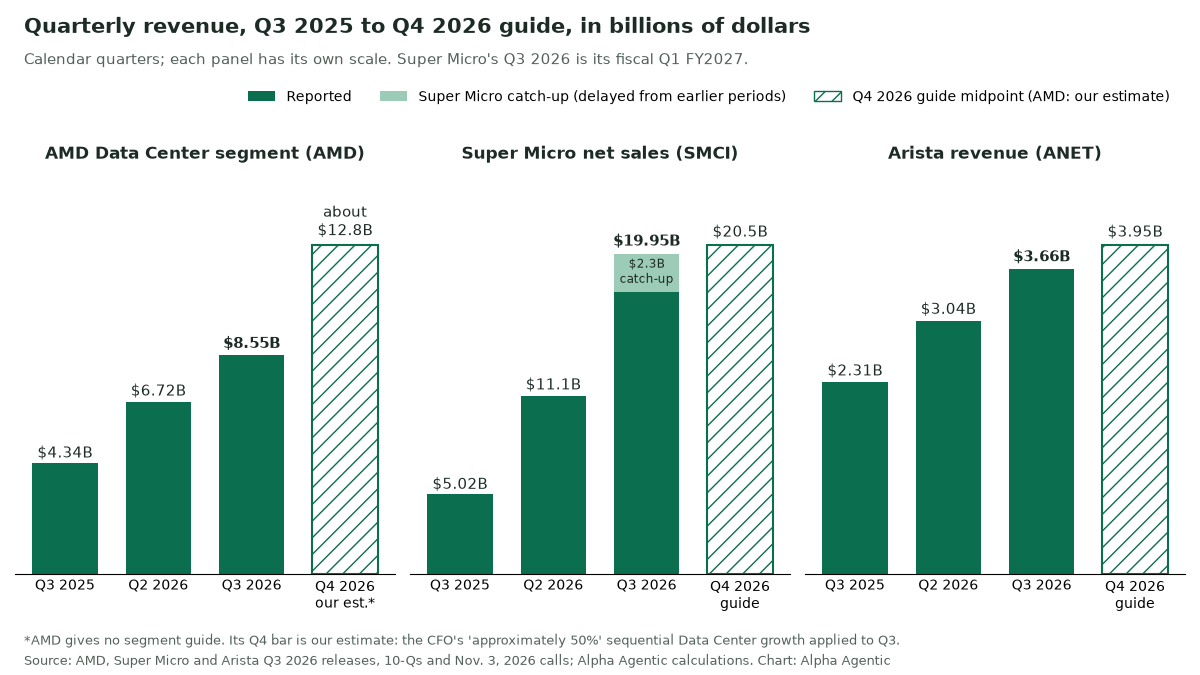
AMD Data Center revenue: $8.55 billion in Q3 2026, up 97% from Q3 2025 and 27% from Q2 2026.
Super Micro net sales: $19.95 billion in Q3 2026, $446 million above the top of its Oct. 20 preliminary range.
Super Micro catch-up: about $2.3 billion of Q3 2026 sales were deployments delayed from earlier periods, the company said; it put underlying sales at about $17.6 billion.
Arista revenue: $3.66 billion in Q3 2026, up 58.5% from Q3 2025 and 10.8% above its $3.3 billion guide.
Q4 2026 guides: midpoints sit 27.1% above Q3 2026 at AMD, 8.0% at Arista and 2.8% at Super Micro.
AMD commitments: $48.8 billion at the end of Q3 2026, against about $30.3 billion at the end of Q2 2026; the two may not be measured the same way.
Graded Against Their Own Guides
All three companies reported Q3 2026 revenue above the guidance they gave in August. Super Micro also topped the narrower range it gave on Oct. 20.
| Benchmark | Company guide (Q3 2026) | Actual (Q3 2026) | Company guide (Q4 2026) |
|---|---|---|---|
| AMD revenue | $12.7B to $13.3B | $13.38B | $16.49B to $17.51B |
| AMD non-GAAP gross margin | About 56% | 56% | About 55% |
| Super Micro net sales, August guide | $14.5B to $15.5B | $19.95B | $19.5B to $21.5B |
| Super Micro net sales, Oct. 20 range | $18.5B to $19.5B | $19.95B | No new range |
| Super Micro gross margin, Oct. 20 range | 12.0% to 12.5% | 12.7% | 12.0% to 12.5% |
| Arista revenue | About $3.3B | $3.66B | $3.9B to $4.0B |
| Arista non-GAAP operating margin | 48% to 49% | 49.1% | 48% to 49% |
Source: AMD and Arista Q2 and Q3 2026 releases; Super Micro's Aug. 11 and Nov. 3 releases and Oct. 20 preliminary update; Super Micro's Q4 2026 margin guide is from its Nov. 3 call. AMD's Q4 range is our math from "$17 billion, plus or minus 3%."
Super Micro against its own range: On Oct. 20, Super Micro said in a preliminary update that sales would land between $18.5 billion and $19.5 billion and gross margin between 12.0% and 12.5%. The Nov. 3 release reported $19.95 billion and 12.7%. By our math, sales came in 2.3% above the top of the range and 5.0% above its midpoint. The 10-Q, filed Nov. 5, shows the same sales figure.
The catch-up: On the call, new CFO Mark Long said about $2.3 billion of sales were "deployments originally scheduled for earlier periods due to customer and data center readiness." Excluding them, he put underlying sales at about $17.6 billion. By our math, that is $0.9 billion below the bottom of the Oct. 20 range and 13.5% above the top of the August guide. Super Micro did not say whether the Oct. 20 range included the catch-up.

AMD: The GPU Read
AMD's Data Center segment had record revenue of $8.55 billion in Q3 2026, up 97% from a year earlier, driven by demand for its EPYC server CPUs and the launch of its MI450 Series GPUs, according to its earnings release.
Mix and margin: Data Center reached 63.9% of AMD's revenue, up from 47.0% in Q3 2025. The segment's operating margin rose to 33.7% from 31.3% in Q2 2026. By our math, AMD kept 42.6 cents of segment operating profit from each added dollar of segment revenue between the two quarters.
The step up: AMD guided Q4 2026 revenue to about $17 billion, plus or minus 3%, about 27% above Q3 2026. On the call, CFO Jean Hu said Data Center revenue should grow about 50% from Q3 2026, and that Q4 will be the first quarter in which data center AI revenue passes server revenue. Applied to Q3, that growth rate gives about $12.8 billion of Q4 Data Center revenue. That is our estimate; AMD gives no segment guide. CEO Lisa Su said she now expects total revenue to grow more than 80% in 2027 and server revenue to double. "It is true that demand is higher than supply," she said.
Warrants: The 10-Q says AMD issued warrants for up to 160 million shares each to two customers, which its risk factors name as OpenAI and Meta Platforms (NASDAQ: META). As MI450 shipments began, AMD booked a $1.1 billion noncash loss in Q3 2026 from the change in the warrants' fair value, leaving a warrant liability of $1.2 billion. A further $4.5 billion of grant-date value will be booked as a reduction of revenue as qualifying customer sales are recognized. No warrant shares had vested by Sept. 26.
Super Micro: The System Builder Read
Super Micro reported net sales of $19.95 billion for Q3 2026, up 79% from Q2 2026 and nearly four times Q3 2025.
Margin: Gross margin fell to 12.7% from 17.5% in Q2 2026. By our math, gross profit rose 31% while sales rose 79%. Long tied the drop to a higher share of large AI deployments, which carry lower margins, and to lower-margin deferred revenue recognized in the quarter. AI solutions were about 71% of revenue, up from 59%.
One customer: The 10-Q says one customer bought 44.0% of Q3 2026 net sales, about $8.8 billion by our math. Super Micro's largest customer took 28.1% of fiscal 2026 sales, its 10-K shows. The United States took 80.1% of Q3 2026 sales, against 36.6% a year earlier.
Prepayments: Deferred revenue rose to $5.67 billion at Sept. 30 from $2.61 billion at June 30, per the balance sheet. Long said "an overwhelming majority" of the rise reflects customers paying before delivery.
Outlook: Super Micro raised its sales outlook for fiscal 2027, the year ending June 2027, to $72 billion to $82 billion, from $65 billion to $72 billion. Long said the range does not assume the catch-up repeats. "What governs the range is not demand, and it is not our ability to build," he said, pointing to customer site readiness and parts supply. He called "land, power and data center shells" the binding constraints on AI build-outs.
Arista: The Network Read
Arista reported Q3 2026 revenue of $3.66 billion, up 58.5% from a year earlier and 20.5% from Q2 2026, in its earnings release. Arista called it the highest year-over-year growth since its IPO.
Guide: Arista guided Q4 2026 to $3.9 billion to $4.0 billion. That puts 2026 revenue just over $13.3 billion at the midpoint, up 48%. On the call, CEO Jayshree Ullal gave a first 2027 outlook of 38% to 40% growth, to about $18.5 billion. She expects revenue from AI fabrics to double to about $7 billion in 2027.
Deferred revenue: Arista's 10-Q shows $1.72 billion of Q3 2026 revenue came out of the deferred balance at the start of the quarter. By our math, that was 46.9% of revenue, against 34.1% in Q2 2026. New deferrals of $1.69 billion almost matched Q2's $1.70 billion, so the balance held near $6.84 billion. CFO Chantelle Breithaupt said the account had its "largest churn in and out" and still stayed flat. She expects it to end 2026 higher than it ended 2025.
Customers: Two end customers took 26% and 16% of Arista's 2025 revenue, the 10-Q says. Ullal said Arista expects "at least 3 and maybe 4" customers above 10% of revenue in 2026.
Analysis: Three Reads, One Constraint
AMD and Super Micro said on their Nov. 3 calls that demand is running ahead of supply, and Arista described industry-wide shortages. AMD and Arista are locking in more supply; Super Micro's commitments slipped.
| Company | Commitments (end of Q2 2026) | Commitments (end of Q3 2026) | Inventory change (Q2 to Q3 2026) |
|---|---|---|---|
| AMD | About $30.3B* | $48.8B | +35.4% |
| Super Micro | $34.2B | $33.3B | +16.7% |
| Arista | $9.7B | $11.4B | +26.6% |
Source: company 10-Qs and Super Micro's fiscal 2026 10-K. Super Micro and Arista report non-cancelable purchase commitments; AMD reports unconditional commitments, which also cover capacity agreements and leases. Inventory changes are Alpha Agentic calculations. *AMD's Q2 figure included cloud service arrangements; its Q3 10-Q lists $6.2 billion of cloud compute commitments separately, so the two figures may not be measured the same way.
Same constraint: Su said demand is higher than supply. Super Micro CEO Charles Liang said key component shortages, including GPUs, are still stretching delivery times across the industry. Ullal cited "widespread industry-wide supply chain constraints and shortages." In our Intel results, Intel (NASDAQ: INTC) CFO David Zinsner said demand "continues to meaningfully exceed available supply," and our AI infrastructure scorecard found supply the tighter limit at six of eight suppliers.
Different responses: AMD and Arista are buying further out. AMD's reported commitments rose to $48.8 billion from about $30.3 billion, though the two figures may differ in scope. Arista's commitments due beyond 12 months rose to $2.1 billion from $0.3 billion, and Breithaupt said they now include a multiyear memory agreement. Super Micro's commitments fell slightly while its deferred revenue, mostly customer prepayments, rose $3.1 billion. In our read, the integrator is funding its build with customer cash rather than locking in more parts.
Timing: Two of the three headline beats were helped by timing. Super Micro's $2.3 billion catch-up was 11.5% of its sales. At Arista, revenue not drawn from the opening deferred balance was $1.94 billion, down 2.9% from Q2 2026, by our math. That figure mixes product and service revenue, and Arista does not guide it. Still, it suggests much of the jump in reported revenue came from customers accepting gear shipped earlier.
Guides: The Q4 2026 guides separate the three. AMD's midpoint is 27.1% above Q3 2026, driven mainly by Data Center. Arista's is 8.0% higher. Super Micro's is 2.8% above reported sales, but 16.5% above the $17.6 billion it called underlying. By our math, its fiscal 2027 midpoint of $77 billion leaves about $18.3 billion a quarter for January through June 2027, below reported Q3 2026 sales and above the underlying figure.
Concentration: Each company leans on a few very large buyers. Super Micro's largest customer took 44% of sales. Arista expects up to four 10% customers. AMD's warrant holders are also among its lead MI450 customers. None of the three reports shows a pullback by those buyers.
The Alpha Take
The three reads agree on direction: all three companies beat their own guides, and all three describe supply as the limit. They differ on pace and on quality. AMD's 27% Q4 2026 step is the strongest signal, but it rests on an MI450 ramp with one quarter of history. Super Micro's underlying $17.6 billion, not the $19.95 billion headline, is the cleaner base for its outlook. Arista's flat deferred balance makes Q4 2026 a test of new shipments rather than acceptances. If commitments and inventory keep rising faster than revenue, a slowdown would show there first.
What to Watch
Nvidia: Nvidia (NASDAQ: NVDA) reports results for the quarter that ended Oct. 25 on Nov. 17, according to its IR release. Super Micro's 10-Q ties much of its sales growth to systems built on Nvidia's GB200 and GB300.
Dell: Dell Technologies (NYSE: DELL) reports on Nov. 24, its IR events page shows. It is the closest public check on Super Micro's server read.
AMD warrants: Hu said AMD will guide on when warrant shares enter its share count once it gets into 2027. Its Q4 2026 share count guide assumes none.
Super Micro customer mix: Long expects concentration to stay high during the current build-outs and ease as enterprise and sovereign sales grow.
Arista deferred revenue: Breithaupt expects the balance to end 2026 above its 2025 level. Our Hyperscaler Capex Tracker follows the cloud spending behind all three.