Chip Equipment Earnings Preview: KLA, Teradyne and Advantest After Lam's Supply Warning
Lam Research grew revenue 22% last quarter but said supply constraints held back its December guide. Five toolmakers, test makers and materials suppliers report next. Here is what each guided and what to watch.
Lam Research (NASDAQ: LRCX) set the tone last week. Its September-quarter revenue rose 22% from the June quarter to a record $8.22 billion, per its Oct. 21 release. It guided December revenue to $8.60 billion, plus or minus $400 million, about 5% higher at the midpoint by our math. On the earnings webcast, CFO Doug Bettinger said that guide would have been higher without near-term supply chain constraints. Lam shares fell 11.8% from the Oct. 21 close to the Oct. 23 close. KLA, Teradyne and Entegris fell 10.9%, 10.6% and 8.9% over the same two sessions.
Five more suppliers report this week. KLA (NASDAQ: KLAC) sells process control tools. Teradyne (NASDAQ: TER) and Advantest (TSE: 6857) make chip testers. Entegris (NASDAQ: ENTG) supplies materials and filtration. Tokyo Electron (TSE: 8035), or TEL, makes deposition, etch and coating tools. Together they show whether AI demand is still pulling equipment forward, and whether Lam's supply limits are an industry problem.
The Schedule and the Bar
Each company's own guidance is the bar. We are not citing analyst consensus.
| Company | Reports (ET) | Own guide for the quarter | Last quarter |
|---|---|---|---|
| Teradyne (TER) | Tue., Oct. 27, 4:30 p.m. or later; call Wed., 8:30 a.m. (notice) | Revenue $1.20B–$1.30B; non-GAAP EPS $1.85–$2.15 | $1.33B |
| Advantest (6857) | Wed., Oct. 28, 2:30 a.m. (3:30 p.m. Tokyo) (IR calendar) | Jul.–Sep. sales ¥434.5B; operating income ¥224.5B | ¥367.5B |
| KLA (KLAC) | Wed., Oct. 28, after close; call 5:00 p.m. (notice) | Revenue $4.0B ± $200M; non-GAAP EPS $1.16 ± $0.10 | $3.66B |
| Entegris (ENTG) | Thu., Oct. 29, before open; call 8:00 a.m. (notice) | Sales $905M–$935M; non-GAAP EPS $0.96–$1.04 | $883.2M |
| Tokyo Electron (8035) | Fri., Oct. 30, 3:00 a.m. (4:00 p.m. Tokyo) (IR page) | Apr.–Sep. net sales ¥1.62T, implying ¥887.7B for Jul.–Sep. | ¥732.3B |
Source: company IR pages and releases, checked Oct. 26, 2026. Reporting times can change; recheck before each report.
Times are ET. Japan does not observe daylight saving time, so Tokyo is 13 hours ahead this week.
KLA: The WFE Call
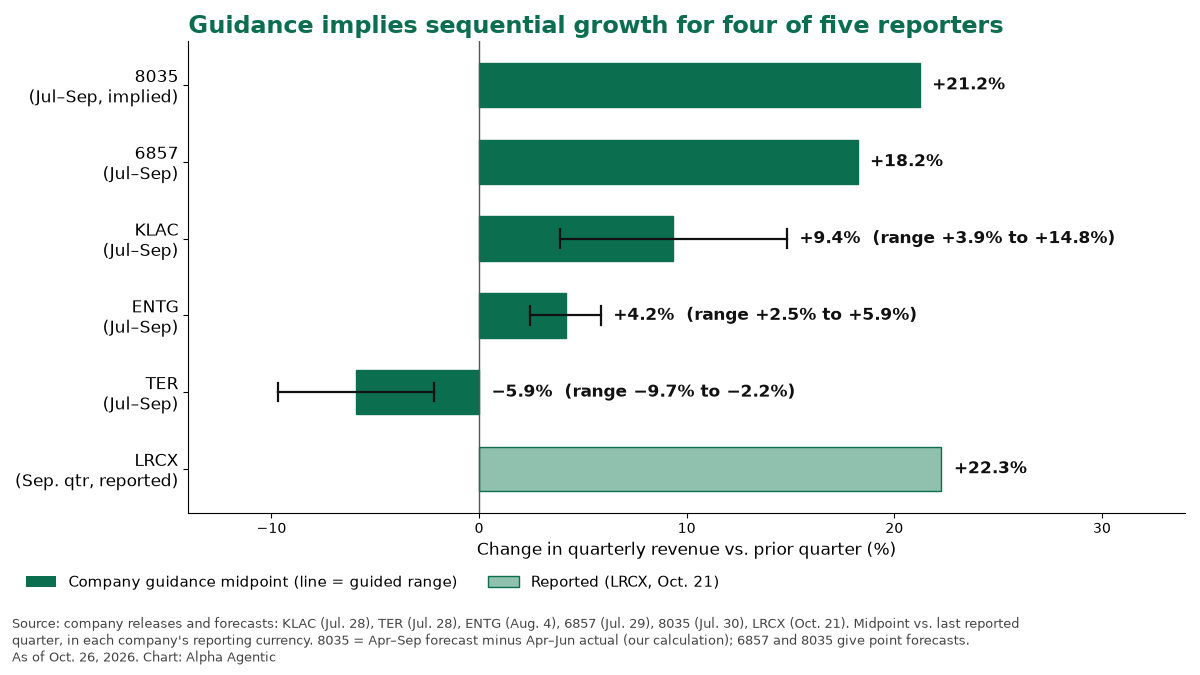
Guide: KLA guided its September quarter to revenue of $4.0 billion, plus or minus $200 million, in its July 28 release. Non-GAAP EPS guidance is $1.16, plus or minus $0.10, after KLA's ten-for-one stock split in June.
WFE: In its shareholder letter, KLA raised its view of 2026 wafer fab equipment spending, including advanced packaging, to "approximately the low $150 billion range," from "$140 billion plus." For 2027 it gave no number, only "significant growth." Lam's presentation now puts 2026 in the "mid-$150B range" and 2027 at more than $200 billion. The question is whether KLA moves toward Lam's view.
Supply: KLA said its expected second-half acceleration was "materializing as more capacity comes online in our long-lead-time supply chain areas." It expects second-half 2026 revenue about 20% above the first half. September results will show whether that held while Lam reported constraints.
Packaging and China: KLA expects advanced packaging process control systems revenue of about $1.1 billion in 2026, up more than 70%. China was 26% of June-quarter revenue, per the letter, and 29.8% of fiscal 2026 revenue, per its 10-K.
Lam's Supply Snags: Shared or Lam-Specific?
Lam's presentation said clean room space and "supply chain constraints for certain components" are limiting the industry's ability to fully meet demand. On the webcast, CEO Tim Archer said that would continue into 2027, but that the situation was not comparable with the COVID-era shortages. China rose to 35% of Lam's September-quarter revenue, from 26% in June, and Lam expects a "significantly lower" share in December. Our Oct. 22 Daily Brief covered the report.
TEL struck a different tone in July. On its July 30 call, management said it was "receiving pull-in request for delivery and additional orders." On supply chain status, it said "there are not any issues to be noted." Friday's report is the first chance to see whether that has changed.
Tokyo Electron: A Record Half
TEL raised its April–September net sales forecast to ¥1.62 trillion, from ¥1.57 trillion, per its forecast page. First-quarter sales were ¥732.3 billion, per its presentation. That implies ¥887.7 billion for July–September, by our math. TEL projects 2026 WFE of $150 billion or more and 2027 of $190 billion or more, and said spending for AI data centers is growing to exceed 50% of the total. China was 30.4% of first-quarter sales; TEL expects a "low 30s%" share for the fiscal year. TEL now gives half-year forecasts only, so its first October–March outlook is the number to watch. In July it said it expected second-half demand growth to be stronger than the first half's.
Teradyne and Advantest: AI Test Demand
Teradyne: Second-quarter revenue more than doubled from a year earlier to $1.33 billion, per its July 28 release. Its guide implies a sequential dip at the midpoint. In its 10-Q, Teradyne said investment by hyperscalers and others in AI data center infrastructure supported compute test revenue. Memory revenue topped $200 million for a third straight quarter on HBM and DRAM test demand. The filing said test sales will stay "concentrated with a limited number of significant customers." CEO Greg Smith said rising WFE investment "sets the stage for continued growth in 2027 and beyond." Cloud buyers' spending is tracked in our Hyperscaler Capex Tracker.
Advantest: First-quarter sales were a record ¥367.5 billion, with a 51.7% operating margin, per its earnings forecast page. In July it raised its full-year sales forecast to ¥1,714.0 billion, from ¥1,420.0 billion. In its Q1 notes, it lifted its 2026 tester market view to $13.0 billion–$14.5 billion. It said tester demand tied to inference AI, including ASICs, CPUs and DRAM, was growing faster than expected. It guided full-year gross margin to 66%–67%, below the first quarter's 69.5%, citing higher costs for memory-related components, mainly in the second half.
Entegris: Materials for New Fabs
Entegris guided third-quarter sales to $905 million–$935 million, per its Aug. 4 release. CEO Dave Reeder said "accelerating customer capital investments" drove double-digit growth in both its unit and capex-related businesses. Its 10-Q put China at 19% of second-quarter sales and Taiwan at 26%. Entegris holds an Investor Day on Nov. 9, so its quarterly comments may be brief.
China and Export Rules
Affiliates Rule: The Commerce Department's Bureau of Industry and Security suspended its "Affiliates Rule" for one year in November 2025, as KLA's 10-K notes. The rule extends export restrictions to entities 50% or more owned by listed parties. The suspension ends Nov. 9 and the rule returns Nov. 10 unless extended. The U.S. and China agreed in September to extend their trade truce to Jan. 10, but as of Oct. 26 no Federal Register notice had moved the rule's return date.
Outbound investment: Separately, the Treasury proposed rules on Oct. 22 to update its outbound investment program under the COINS Act, covering semiconductors, AI and other technologies. The proposal targets U.S. investment in covered foreign companies, not equipment sales, and is open for comment. Our Oct. 26 Daily Brief has details.
The Alpha Take
Four of the five point to sequential growth, and all of it depends on tools and testers shipping on time. If KLA and TEL land near their guides without supply caveats, Lam's constrained December guide looks company-specific. If they echo Lam's component limits, 2027 WFE forecasts of $190 billion to more than $200 billion may be capped by supply, not demand. For Teradyne and Advantest, the read is narrower: whether AI test demand broadens beyond a few large customers, and whether memory costs squeeze Advantest's margin.
What to Watch
KLA WFE view: Does "low $150 billion" for 2026 move up, and is there a first 2027 number to set against Lam's more than $200 billion?
Supply language: Do KLA and Tokyo Electron cite component or long-lead-time constraints, as Lam did?
Teradyne: Revenue against $1.20 billion–$1.30 billion, the split between compute and memory test, and the fourth-quarter guide.
Advantest: Sales against its ¥434.5 billion forecast, any change to the $13.0 billion–$14.5 billion tester market view, and margin effects from memory costs.
Tokyo Electron: Its first October–March forecast and any update to its 2027 WFE view of $190 billion or more.
Entegris: Sales against $905 million–$935 million, and any preview of Nov. 9 targets.
China: Each company's China share, and any comment on the Affiliates Rule's Nov. 10 return date.