Datacenters in Orbit: The Physics Works. The Spreadsheet Doesn't Yet.
Grid limits are pushing AI compute toward orbit. We ran the physics and the math. At today's roughly $3,600/kg launch price, orbital power costs about 12 to 34 times a typical U.S. grid price. Break-even needs roughly $100 to $300 per kg, so this is a Starship story before it is an AI story.
Updated Nov. 8, 2026: Added The Alpha Take with SpaceX's Q3 2026 disclosures and other developments since publication, and replaced a broken fund holdings link.
The thesis
Orbital datacenters are real engineering, not science fiction. Chips have flown, models have run in orbit, and the largest space and AI companies have filed plans. But at today's launch prices the economics are off by an order of magnitude.
Our view: orbital compute becomes cost-competitive with grid-powered datacenters only when launch prices fall to roughly $100–300 per kg, and only if spacecraft can carry power, radiators and chips at about 15–20 kg per kW. That makes the sector a bet on Starship-class reusable launch more than on chips or solar cells. Near term, expect demonstrations and niche, defense-flavored edge computing; gigawatt-scale "AI factories in the sky" are a 2030s question at best.
For public-market investors, the exposure is narrow. SpaceX (NASDAQ: SPCX), which began trading on Nasdaq on June 12 after pricing its IPO at $135 a share, is the most direct listed way to own the theme. Almost everything else is indirect.
Why now: the grid is the bottleneck
The pitch for orbit starts with trouble on the ground, which our power and grid deep dive covers.
The Financial Times reported on Oct. 18 that at least 47 large U.S. datacenter projects had been delayed, withdrawn or blocked since the start of 2026, citing regulatory-data firm RegLayer, which called the count conservative. The same report, as summarized by Korea's Financial News, cited a Bernstein estimate that only about 35% of planned U.S. projects are viable, and FT research finding that more than 1,000 U.S. communities had tried this year to restrict AI infrastructure.
In Britain, Microsoft (NASDAQ: MSFT) pulled out of a deal to lease capacity at Nscale's planned site in Loughton, Essex, after Nscale was told the site would not get grid power until the 2030s. Microsoft confirmed the exit on Oct. 19, saying the decision "relates to a single site." Nscale says it is exploring alternative power sources.
Space offers what Earth lacks: room, no interconnection queue, no zoning board and near-constant sun. Google, part of Alphabet (NASDAQ: GOOGL), says a solar panel in the right orbit can be up to eight times more productive than one on Earth. When SpaceX acquired xAI on Feb. 2, Elon Musk wrote that "space-based AI is obviously the only way to scale." He also predicted that "within 2 to 3 years, the lowest cost way to generate AI compute will be in space."
The physics and engineering
Power: sunlight is the easy part
Above the atmosphere, sunlight delivers about 1,361 W per square meter. In a dawn–dusk sun-synchronous orbit, a satellite rides the line between day and night and sees near-constant sun. That is the orbit Google proposes for Project Suncatcher. In a typical low orbit, by contrast, a spacecraft can spend roughly a third of each 90-to-95-minute orbit in Earth's shadow and needs heavy batteries.
Analysis: Using Google's own assumptions of 22% cell efficiency and 90% packing, a panel yields about 270 W per square meter. One megawatt needs roughly 3,700 m² of array, about half a soccer pitch. SpaceX's AI1 design assumes a similar 250 W.
Heat: the real constraint
In a vacuum there is no air or water to carry heat away. Every watt a chip uses becomes heat that must be radiated away. The Stefan–Boltzmann law sets the limit:
q = ε · σ · T⁴, where σ = 5.67 × 10⁻⁸ W/m²·K⁴
Worked example: Our math assumes emissivity ε = 0.9 and ignores incoming sunlight and Earthshine, which make real radiators worse. All figures are rounded.
| Radiator temperature | Heat out per m², one face | Area per MW, two-sided | Area per MW, one-sided |
|---|---|---|---|
| 300 K (27°C) | 413 W | 1,210 m² | 2,420 m² |
| 330 K (57°C) | 605 W | 830 m² | 1,650 m² |
| 350 K (77°C) | 766 W | 650 m² | 1,310 m² |
First row: 0.9 × 5.67 × 10⁻⁸ × 300⁴ ≈ 413 W/m², so 1 MW needs 1,000,000 ÷ 826 ≈ 1,210 m² of two-sided panel.
Because of the fourth-power term, hotter radiators shrink fast, but chips must then run hotter. Starcloud's white paper estimates about 633 W net per square meter of two-sided radiator at 20°C, after subtracting absorbed sunlight and Earth heat. SpaceX says AI1 will carry up to 110 m² of deployable liquid radiators for 120 kW of sustained compute, about 1.1 kW per square meter. Musk said the design assumes about 1,400 W per square meter, radiating from both sides. By our math that needs panels near 342 K, or about 69°C, even before environmental heat is counted.
The takeaway: an orbital megawatt needs thousands of square meters of solar arrays plus hundreds to thousands of square meters of radiators. Mass is the binding cost.
Radiation: better than feared, not solved
Commercial chips are not radiation-hardened. Particles cause bit flips, and total dose degrades parts over time.
The early data is encouraging. Google tested its Trillium TPU in a 67 MeV proton beam. High-bandwidth memory was the most sensitive part but showed irregularities only after a 2 krad dose, nearly three times the expected shielded five-year dose of 750 rad. No hard failures were seen up to 15 krad. Starcloud-1 flew an Nvidia (NASDAQ: NVDA) H100 and trained a small model in orbit. Google's paper still notes that bit-flip rates acceptable for inference may be less tolerable for long training runs.
Launch mass and cost
Historical launch cost to low Earth orbit ranged from about $61,700/kg for the Space Shuttle to $2,720/kg for Falcon 9 and $1,410/kg for Falcon Heavy, in 2018 dollars at maximum payload. Google uses $3,600/kg as today's Falcon 9 price in its reusable configuration, the one used for Starlink. That is higher than the 2018 list figure because a reusable booster carries less than the expendable maximum payload.
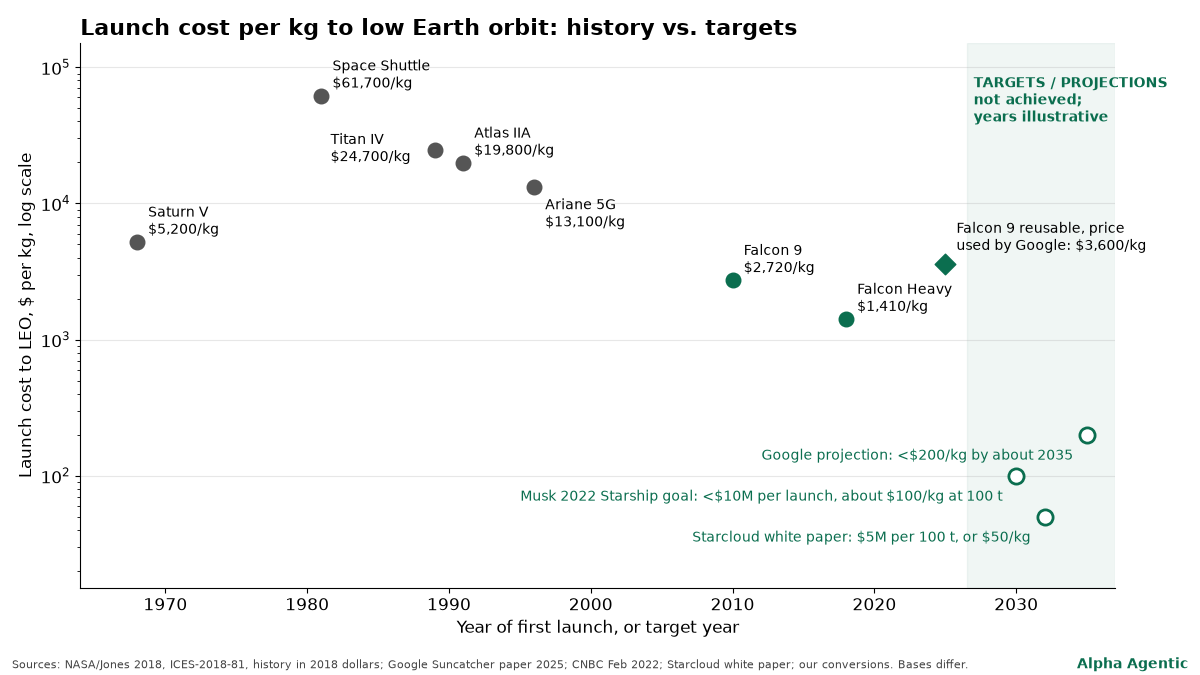
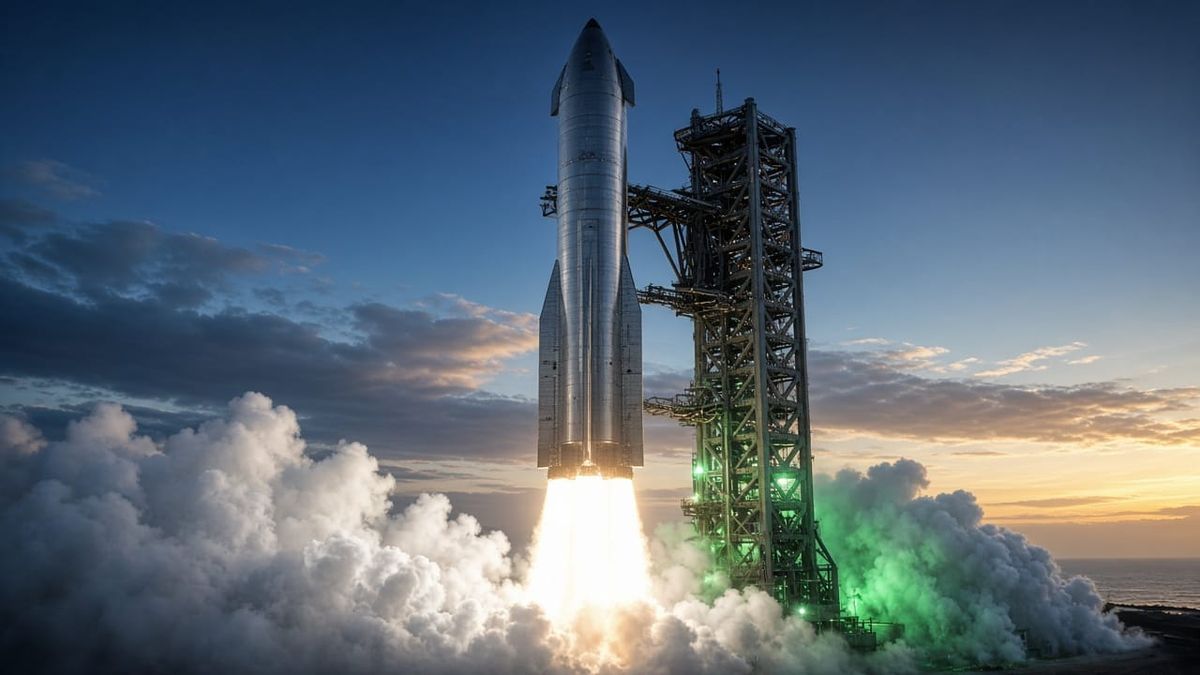
Starship reached orbit for the first time on Sept. 28, on its 14th flight, and deployed 26 Starlink V3 satellites. The mission was cut short after an engine shut down early. SpaceX has published no commercial price per kg. Musk said in 2022 he was "highly confident" a Starship launch would cost less than $10 million; at 100 tons of payload, that would be about $100/kg.
Latency and bandwidth
At 600 km, a satellite is about 2 ms from the ground, fine for inference. Bandwidth is harder. Google says datacenter-class performance needs links between satellites of tens of terabits per second. Its answer is satellites flying hundreds of meters apart, linked by lasers; a bench demo hit 1.6 Tbps with a single transceiver pair. Axiom Space's orbital nodes use 2.5 Gbps optical links. SpaceX's FCC application says its datacenter satellites would rely on optical links that can connect to Starlink satellites.
Maintenance and obsolescence
Nobody swaps a failed GPU at 600 km. Google models a five-year satellite life, roughly the useful life of an AI accelerator. The catch: every hardware generation means relaunching the whole stack, including arrays and radiators that would last decades on the ground.
Debris and congestion
ESA's statistics count about 47,140 objects regularly tracked in orbit. SpaceX has asked the FCC to authorize up to one million orbital datacenter satellites. Blue Origin's Project Sunrise filing covers up to 51,600, and Starcloud has applied for up to 88,000. Licensing could become a gating factor.
Unit economics: a transparent back-of-envelope
Orbital and terrestrial datacenters buy the same chips. The difference is how they pay for power and cooling: on Earth, the utility every year; in orbit, once, upfront, to launch arrays and radiators. So the key comparison is launch cost per kW per year versus grid power cost per kW per year.
Our formula:
- Orbital cost per kW-year = launch $/kg × spacecraft kg per kW ÷ lifetime in years.
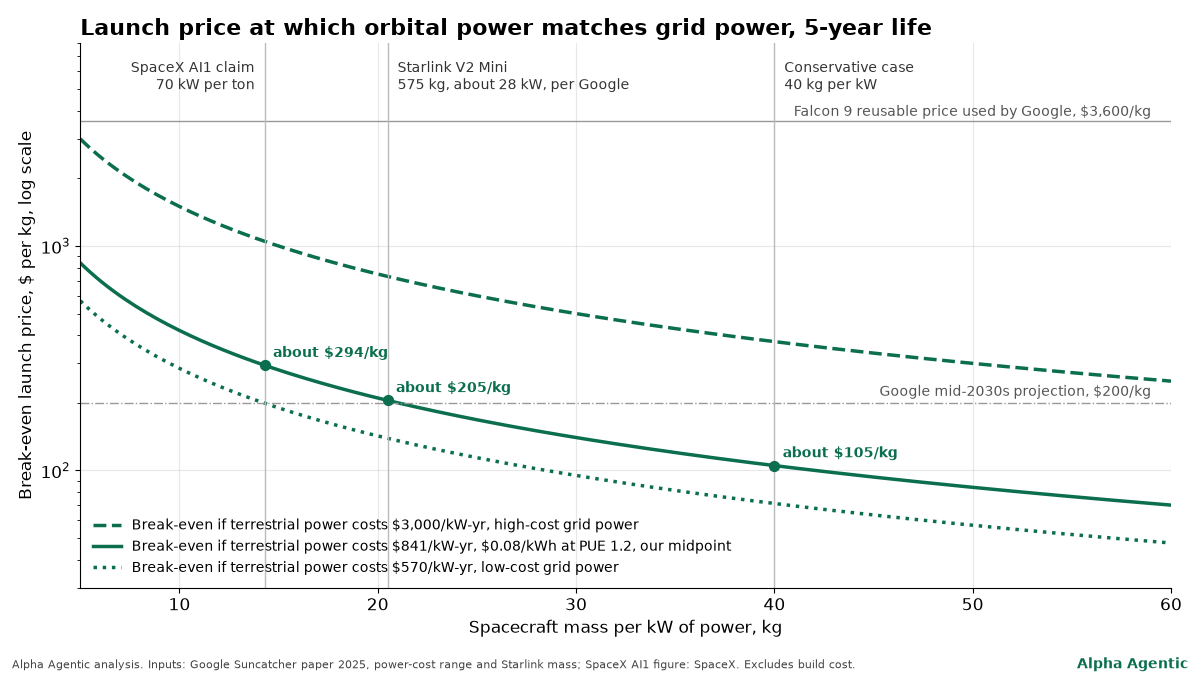
- Break-even launch price = terrestrial power cost per kW-year × lifetime ÷ kg per kW.
Inputs:
- Terrestrial power: Google's paper cites $570–3,000 per kW-year for U.S. AI datacenters, from $0.06–0.25/kWh and PUE of 1.09–1.4. Our midpoint: $0.08/kWh × 8,760 hours × PUE 1.2 ≈ $841 per kW-year.
- Mass: Starlink V2 Mini at about 20.5 kg/kW, from 575 kg and an estimated 28 kW, per Google. SpaceX claims 70 kW per ton for AI1, or 14.3 kg/kW. We add a conservative 40 kg/kW case.
- Life: five years, as in Google's model.
- Launch: $3,600/kg today; $200/kg as Google's mid-2030s projection.
| Mass per kW | Cost per kW-yr at $3,600/kg | Multiple of $841 grid | Break-even launch price |
|---|---|---|---|
| 14.3 kg (SpaceX AI1 claim) | $10,300 | 12x | about $294/kg |
| 20.5 kg (Starlink V2 Mini) | $14,760 | 18x | about $205/kg |
| 40 kg (conservative) | $28,800 | 34x | about $105/kg |
At Google's $200/kg mid-2030s projection, the same three designs would cost $570, $820 and $1,600 per kW-year. Against the full $570–3,000 grid range rather than our midpoint, break-even runs $199–1,049/kg at 14.3 kg/kW, $139–732/kg at 20.5 kg/kW and $71–375/kg at 40 kg/kW. Google's table shows $14,700 and $810 for Starlink; the gap is rounding.
What this means:
- At today's roughly $3,600/kg, orbit loses badly. Launched power costs roughly 12 to 34 times our midpoint U.S. grid cost.
- Google's conclusion holds up: below $200/kg, which it projects for the mid-2030s, costs become "roughly comparable." Its paper says reaching that price on a 20% learning curve would take about 370,000 additional tons launched, roughly 1,800 Starship flights.
- The model is generous to orbit. Like Google's, it ignores satellite build costs, ground stations, insurance and launch failures, partly offset by ignoring terrestrial building costs.
Where company claims fall apart: Starcloud's white paper compares a 40 MW cluster over 10 years: $167 million on land versus $8.2 million in space. Its cost table assumes a single $5 million launch carrying the compute, solar and radiators for all 40 MW. Two problems:
- The paper converts $5 million per 100 tons to "approximately $30 per kilogram." The arithmetic gives $50/kg.
- At 14.3–20.5 kg/kW, 40 MW of spacecraft weighs roughly 570–820 tons. That is six to nine 100-ton launches, not one. The paper's own launch section says a similar number of launches would be needed for solar and radiator modules as for compute, but the cost table does not reflect it.
At $50/kg and our mass range, launch would cost about $29–41 million, still far below the paper's $140 million estimate for 10 years of land-based electricity. So the claim survives if sub-$100/kg launch arrives. At $1,000/kg, launch alone would cost $570–820 million, and it does not.
Who's doing what
| Player | What's verified | Date |
|---|---|---|
| Starcloud (private) | H100 satellite launched; raised $250M at a $2.3B valuation | Nov. 2, 2025; Aug. 21, 2026 |
| Google (Project Suncatcher) | Plan announced with Planet Labs (NYSE: PL); four-TPU prototype launched | Nov. 4, 2025; Oct. 1, 2026 |
| SpaceX / xAI | FCC application for up to 1M satellites; acquired xAI | Jan. 30, 2026; Feb. 2, 2026 |
| Blue Origin (private) | Project Sunrise FCC application for up to 51,600 satellites | Mar. 19, 2026 |
| Nvidia | Announced Space-1 Vera Rubin module for orbital datacenters | Mar. 16, 2026 |
| Cowboy Space (formerly Aetherflux) | Reason-1 power-beaming test launched on Transporter-18 | Oct. 1, 2026 |
| Axiom Space (private) | Two ARC compute nodes operational on Kepler satellites | Oct. 6, 2026 release |
| Sophia Space (private) | $10M seed round | Feb. 26, 2026 |
| Lonestar Data Holdings (private) | Payload flew on the IM-2 lander from Intuitive Machines (NASDAQ: LUNR), which tipped over | Feb.–Mar. 2025 |
| China: ADA Space | First 12 computing satellites launched; batch of eight launched | May 14, 2025; Oct. 14, 2026 |
More detail on the players:
- Starcloud: Nvidia and Cisco (NASDAQ: CSCO) are among its investors. Starcloud-1 flew on SpaceX's Bandwagon-4 and trained a small model in orbit. Two 8 kW Starcloud-2 satellites are planned on 2027 rideshares.
- Google: the prototype flew on SpaceX's Transporter-18. Two follow-up satellites are planned for 2027.
- SpaceX: its AI1 design was shown at 150 kW peak and 120 kW sustained. Demos are targeted by late 2027, per Reuters sources in June 2026, and the IPO filing cites deployment "as early as 2028."
- Blue Origin: we found no launch timeline.
- Cowboy Space: Reason-2, with H200 GPUs, is targeted for the first half of 2027.
- Axiom Space: its nodes ride Kepler Communications' optical relay satellites, launched earlier this year.
- Sophia Space: plans an in-orbit demo of its passively cooled computers by late 2027 or early 2028.
- Lonestar: says most tests ran.
- ADA Space: the first batch was built with Zhejiang Lab; the second launched on a LandSpace Zhuque-2E. It plans 2,800 satellites.
- ASCEND: the EU-funded study found that cutting emissions would need a launcher ten times less emissive over its lifecycle.
Timeline: what has flown and what's next
Flown: Lonestar, March 2025; ADA Space's first batch, May 2025; Starcloud-1, November 2025; Axiom's nodes, 2026; Google's Suncatcher prototype and ADA Space's second batch, October 2026. Based on company disclosures, none exceeds roughly 10 kW per satellite.
Company plans, as stated: Starcloud-2 and Google's two follow-up satellites in 2027; Cowboy Space's Reason-2 in the first half of 2027; SpaceX demos by late 2027 and deployment as early as 2028; Sophia's demo in late 2027 or early 2028; Kepler's dedicated Neutron launch with Rocket Lab (NASDAQ: RKLB) no earlier than 2028; and Cowboy Space's 1 MW datacenter upper stage, targeted for December 2028.
Our assessment, analysis rather than company guidance:
- 2 years, late 2028: Several 10–150 kW satellites running inference and defense edge workloads, including first AI1 units if Starship flies regularly. No grid-competitive economics yet.
- 5 years, 2031: Starship-class pricing becomes visible; tens-of-megawatts constellations, mostly SpaceX's, are plausible. The test is whether outside customers pay.
- 10 years, 2036: If launch reaches about $200/kg, orbital compute could be a real, if minority, slice of AI capacity. If launch stalls above $500/kg, the sector stays a niche for sovereign, defense and Earth-observation processing.
Related stocks and how material the exposure is
Prices are Oct. 16, 2026 closing prices, the latest full session.
| Company | Price | Link to orbital compute | Materiality |
|---|---|---|---|
| SpaceX (NASDAQ: SPCX) | $146.03 | Builds the launcher, the satellites and the laser network | Meaningful; the purest listed exposure |
| Alphabet (NASDAQ: GOOGL) | $340.59 | Suncatcher; SpaceX shares carried at $94.1B on June 30 | Small relative to Alphabet's size |
| EchoStar (NASDAQ: ECHO) | $85.37 | Due up to about 261.8M SpaceX shares from spectrum sale | Indirect but large; shares not yet delivered |
| Nvidia (NASDAQ: NVDA) | $214.13 | Space-1 module; Starcloud investor | Tiny today |
| Amazon (NASDAQ: AMZN) | $250.00 | No orbital-compute program found | Tiny/indirect |
| Rocket Lab (NASDAQ: RKLB) | $50.84 | Space solar arrays; launch; Neutron deal with Kepler | Modest, optional; real if the market forms |
| Planet Labs (NYSE: PL) | $13.56 | Built Google's Suncatcher prototype | Small but direct |
| Intuitive Machines (NASDAQ: LUNR) | $10.78 | Carried Lonestar's lunar payload | Tiny |
| Microchip (NASDAQ: MCHP) | $73.85 | Radiation-tolerant chips, space electronics; Lonestar's payload ran on its FPGA | Tiny |
| Teledyne (NYSE: TDY) | $618.60 | Radiation-tolerant chips, space electronics | Tiny |
| Procure Space ETF (NASDAQ: UFO) | $39.28 | SPCX is top holding at 14.29% (fund page, Nov. 6) | Diversified basket |
| ARK Space & Defense Innovation ETF (Cboe BZX: ARKX) | $29.88 | SPCX is top holding at 11.19% (holdings file, Oct. 19) | Diversified basket |
Notes on the table:
- SpaceX: orbital compute is central to its long-term growth pitch, though Starlink and launch drive the business today.
- EchoStar: it is due to receive up to about 261.8 million SpaceX shares at the second closing of its spectrum sale, targeted for Nov. 30, 2027. By our calculation, that stake is worth about $38 billion at the Oct. 16 SPCX close, vs. roughly $25 billion for EchoStar's own equity.
- Amazon: Blue Origin is owned by Jeff Bezos, not Amazon.
- Rocket Lab: Kepler's satellites host compute.
- Microchip and Teledyne: the shift to commercial chips may even work against rad-hard parts.
Other space names that often trade with the theme, such as Redwire (NYSE: RDW) and AST SpaceMobile (NASDAQ: ASTS), have no orbital-compute role we could verify. This is analysis, not investment advice.
Bull case vs bear case
Bull case: Grid constraints are worsening. Starship reached orbit in September. SpaceX has the launcher, the satellite factory and the laser network, plus a captive AI customer in xAI. If launch hits even Google's more cautious $300/kg mid-2030s scenario, our model says orbital power at AI1-like mass roughly matches our midpoint grid cost and beats expensive grids.
Bear case: The economics rest on launch prices more than 10 times below today's, which no vehicle has demonstrated. Most comparisons, ours included, leave out satellite build costs. Hardware can't be repaired and ages out in about five years. Arrays and radiators scale linearly with every megawatt. Debris and licensing risk grow with every filing. And Earth may fix its own problem with gas, nuclear and grid upgrades.
What would change the picture: a published Starship price per kg; an orbital cluster running paying workloads; a year of measured failure rates; a hyperscaler capacity contract.
The bottom line
Orbital compute is a launch-cost story wearing an AI costume. The physics clears, the radiators are buildable and chips survive better than expected. What does not clear today is the bill: at $3,600/kg, launched power costs more than 10 times grid power, and that is before the satellites themselves are paid for.
The break-even sits near $100–300 per kg. Only Starship-class rockets have a credible path there, which is why SpaceX is the center of gravity and why most "space datacenter" stock stories are thin. Musk's two-to-three-year prediction would need a more-than-tenfold launch price drop in that window. Treat 2027–2028 demonstrations as engineering milestones, not proof of a business. The proof will be a price per kg and a paying customer.
The Alpha Take
Analysis: The economics in this piece still point one way. Orbit needs launch near $100 to $300 per kg, against roughly $3,600 today, and nothing disclosed since Oct. 19 moves that number. What changed is the evidence on the ground.
SpaceX is spending on the ground first: SpaceX's Q3 2026 release shows $16.4 billion of capex in its Super Intelligence (SI) segment in the quarter and $40.0 billion in the first three quarters of 2026. Its nameplate compute reached 1.7 GW at Sept. 30. On Oct. 26, it disclosed a binding commitment to lease GPU pods from an entity managed by Apollo Global Management (NYSE: APO), with principal payments of roughly $40 billion over lease terms of five to five and one-quarter years, starting in H1 2027. A keyword search by Alpha Agentic found no mention of orbital or space-based compute in the release or the 10-Q. Our SpaceX Q3 2026 analysis put the SI segment's adjusted EBITDA margin at roughly 66%. With margins like that on the ground, SpaceX has little reason to rush compute into orbit.
Five years is the ground benchmark too: The Apollo lease terms line up with the five-year satellite life in our model. Chips age out on the same clock in both places; orbit's extra cost is relaunching arrays and radiators each generation.
The launch math got more concrete: The 10-Q reports 1,517 metric tons to orbit in the first three quarters of 2026, down from 1,627 tons a year earlier, or roughly 2,000 tons a year. One gigawatt at 14.3 to 20.5 kg per kW weighs 14,300 to 20,500 tons. By our math, that is seven to ten years of SpaceX's entire current launch output for a single gigawatt. The 370,000 additional tons Google says it would take to reach $200 per kg would take roughly 180 years at that pace. All Starship launches to date have been internal, the 10-Q says.
The first demo shows the constraint: Google's Suncatcher prototype is online, TechCrunch reported on Oct. 30. It generates up to 1 kW and can run only one of its four TPUs at a time, for about 20 minutes. Power, not chips, sets the limit for now.
What would change the view: A successful Starship Flight 15, which Elon Musk has targeted for November with an attempt to catch both stages if regulators approve, per Space.com, followed by fast reflights. A published price per kg. A first customer Starship launch. A paying orbital compute contract. Or falling GPU rental margins on the ground, which would shrink what SpaceX gives up by putting capital into orbit.
What to Watch
- Starship cadence and pricing: Reflights, payload to orbit and any public $/kg figure.
- Google's 2027 follow-up satellites: Can optical links carry distributed ML workloads?
- SpaceX AI1 demos, targeted by late 2027: and what the company discloses about cost and customers.
- Starcloud-2 performance: at 8 kW, its first commercial-scale power test.
- FCC actions: on the SpaceX, Blue Origin and Starcloud filings.
- China's constellation: build-out and any measured compute results.
- Grid relief on Earth: Faster interconnection or cheap new generation weakens the case for orbit.